Section 172 report, engagement with stakeholders, cross reference to other disclosures and to governance

GlaxoSmithKline plc – Annual report – 31 December 2024

Industry: pharmaceuticals

Corporate governance (extract)

Engagement

Prioritising continuous engagement

Our stakeholders rightly have high expectations of us, and our dynamic operating environment presents many challenges and opportunities. As a Board, we aim to balance our commercial success with our stakeholders’ expectations, upholding our reputation, maintaining our licence to operate and building trust. We engage with, or are briefed about, our stakeholders’ views to make sure we identify and respond to their expectations effectively and appropriately.

How we engage with our main stakeholder groups – including patients, shareholders, customers and our people – is covered in the pages of the Strategic report.

Patients and our people are the heart of our culture. Our people are accountable for outcomes and committed to doing the right thing. Our culture is described on pages 58 to 60 of the Strategic report.

The influence and importance of different stakeholder groups can vary, depending on the matter being considered. Certain stakeholders’ interests can be in conflict, meaning that we, as a Board, need to make balanced judgements.

Continuous stakeholder engagement and feedback helps us identify emerging issues. It also enables us to make decisions in the context of what is relevant and important to each of them.

Our principal Board committees, and the GLT, undertake engagement on the Board’s behalf according to their remit. This means that they can build a detailed understanding of how our actions or plans are affecting or might affect stakeholders. These insights are then shared with the Board.

In particular, the Board receives briefings on stakeholders’ perspectives from the work of the Corporate Responsibility Committee, which is discussed on pages 137 and 138.

Board members regularly receive:

  • the CEO’s Board report
  • a specific external stakeholder insights report. This provides strategic insights based on an analysis of key developments, achievements and risks affecting our reputation and the perceptions of all our external stakeholders
  • a regular investor relations report which summarises investor perceptions
  • regular corporate governance, litigation and regulatory updates

The Board also learns of stakeholders’ views through:

Engagement and feedback events: such as quarterly investor results calls, the Annual General Meeting, employee survey reports, the Board’s workforce engagement activities, and from experts presenting at Board or committee meetings. The Chair also holds regular investor check-in meetings, which the Senior Independent Non-Executive Director, Charles Bancroft, sometimes joins, and is available for individual meetings with investors.

Other opportunities: Board members also receive wider stakeholder views during the annual strategy meeting with the GLT, as part of the yearly review of strategy, budget and planning processes. This also includes a review of specific aspects of the company’s policies or strategy. In addition, Board members are encouraged to meet individually with employees, shareholders and other key stakeholders during their induction, and then on an ongoing basis. They are expected to report to the Board on such experiences where relevant and material.

Engaging with our shareholders

As a Board, we aim to directly engage with and be directly accountable to institutional investors and private retail shareholders. We do this in several ways, including regular communications, the Annual Governance Meeting, our Annual General Meeting, and through the work of our Investor Relations team, the Chair, Jonathan Symonds, and our Company Secretary, Victoria Whyte. Our Senior Independent Non-Executive Director, Charles Bancroft, is another point of contact for our shareholders.

Each quarter, our CEO, Emma Walmsley, and CFO, Julie Brown, give results presentations to institutional investors, analysts and the media by webcast. They are also regularly joined by the Chief Scientific Officer, the Chief Commercial Officer, and CEO, ViiV Healthcare and President, Global Health, GSK. They are able to provide investors with more detailed insights into their specific areas of responsibility.

Through regular meetings, Emma and Julie each have an ongoing and active dialogue with institutional shareholders about the company’s performance, plans and objectives. In 2024:

  • CEO: 69 engagements, representing 36% of the company’s issued share capital
  • CFO: 134 engagements, comprising 41% of the company’s issued share capital

Our Chair maintains a consistent dialogue with shareholders too – including fund and portfolio managers – and regularly engages with governance and sustainability professionals. During 2024, and up to the date of publication of this Annual Report, Jon held over 30 individual meetings with a range of institutional shareholders, and met or corresponded with shareholders which make up approximately 60% of the company’s share capital. This enables him to gain a current understanding of shareholders’ views, insights and perspectives of the company. He also discusses the continual evolution of the many aspects of Board governance, performance oversight and succession.

Annual Governance Meeting

We held this year’s hybrid meeting in central London at our new HQ. We invited institutional shareholders (representing approximately 60% of our share capital), key investment industry bodies and proxy advisory firms. Approximately 25 representatives of various institutional shareholders and proxy advisers attended the event, comprising around 30% of GSK’s share capital.

The meeting is designed to be as interactive as possible. It began with our Chair sharing the Board’s priorities and focus for 2024 and beyond, with our Remuneration Committee Chair then giving an update on the initial 2025 Remuneration Policy proposals. Our Chair, Remuneration Committee Chair and our Non-Executive Directors then held an informal and open discussion of those issues on shareholders’ minds, which helped foster a richer dialogue.

The key themes covered included the:

  • Board’s focus on value creation, governance and oversight of strategy
  • Board focus areas of 2024
  • Initial proposals for the 2025 Remuneration Policy

The meeting was well received and shareholder feedback was shared with the Board.

Annual General Meeting

We were pleased to hold the company’s AGM at the Royal Lancaster Hotel in May 2024 for shareholders to attend in-person or virtually (a hybrid meeting). We welcomed 125 shareholders in person and 38 shareholders virtually via the Lumi platform to watch and hear updates from our Chair and the CEO, ask questions and to vote. Our shareholders approved all resolutions, with majorities ranging from 92% to 99%.

Our hybrid AGM this year will be held at a new venue, The Landmark London hotel in Central London, which is located near our new global headquarters. For more details see page 322.

Engaging with our people

We have well-established and strong engagement mechanisms with our employees, which the Board monitors regularly. These engagement mechanisms are described on pages 58 to 60. Four key governance channels help the Board understand what our people are thinking:

  • regular Board updates from our Chief People Officer and the CEO on culture and talent (please see pages 58 to 60 for further details on our culture and people)
  • feedback from an annual employee engagement survey, including questions on engagement, confidence and inclusivity
  • a range of pulse surveys of different-sized employee groups to help check sentiment on a quicker and more frequent basis, and to provide valuable insights on the impact of major initiatives, events or communications and direct engagement by the Board

Workforce engagement: Before the company’s demerger, the Board reviewed its formal workforce engagement arrangements. We decided to move from a specific Workforce Engagement Director model and to apply an ‘alternative arrangement’ to the three methods set out in the FRC Code.

Given that the GSK Board was refreshed in terms of tenure with a renewed purpose and focus as a global biopharma company, we considered at that time the importance of adopting a collective Board engagement model. The Board continues to agree this to be the most effective approach to ensure it hears employees’ views directly.

The model operated effectively in 2024 through:

  • in-person receptions with local employees during Board site visits, including in Durham (North Carolina, US), Boston (Massachusetts, US) and our new global headquarters in central London
  • the Chair’s site visits, including to Upper Providence (Pennsylvania, US) and Wavre (Belgium)
  • the Chair’s attendance at management meetings, including Saudi Arabia and China
  • the Chair and Corporate Responsibility Committee Chair organising and attending ongoing meetings with leaders of our employee resource groups to talk about how they experience GSK and to hear their suggestions to further enhance support and ensure that we meet the needs of all our employees to enable them to do their best work for GSK
  • a variety of bespoke engagements that have enabled a broad and open dialogue and facilitated first-hand engagement discussions between the Non-Executive Directors and our people individually and as part of small groups, encompassing perspectives on our strategy, purpose and Ahead Together culture

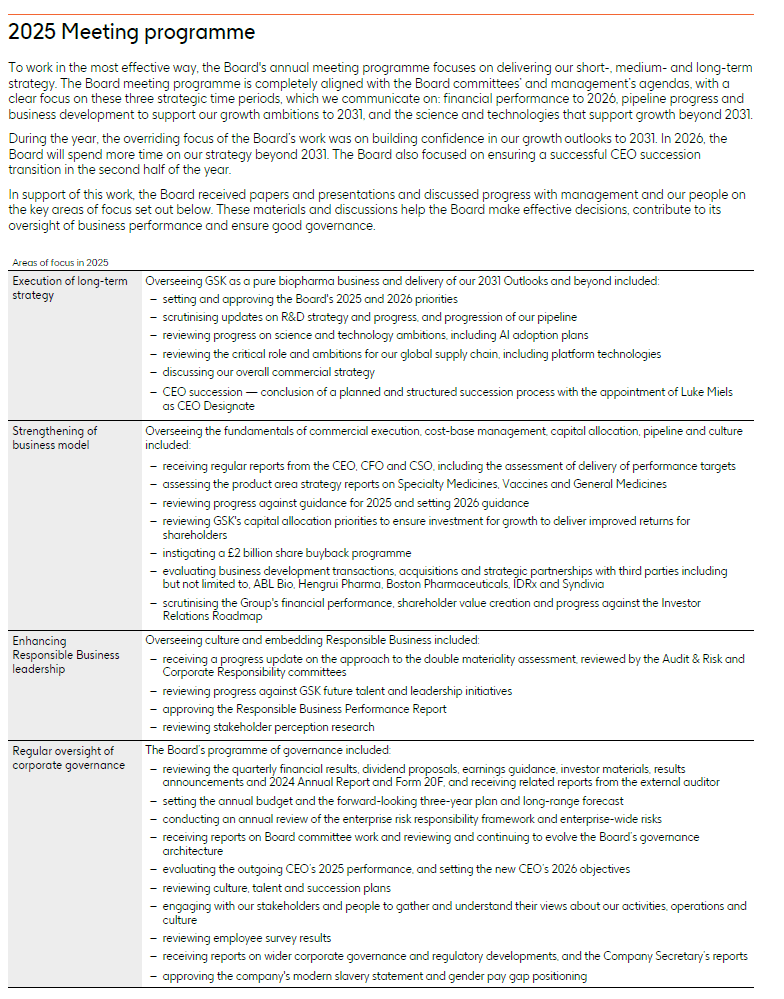
Meeting programme

To work in the most effective way, the Board’s annual meeting programme focuses on delivering our short-, medium- and long-term strategy. The Board meeting programme is completely aligned with the Board committees’ and management’s agendas with a clear focus on these three strategic time periods that we communicate on – financial performance to 2026, pipeline progress and business development to support our growth ambitions to 2031, and the science and technologies that support growth beyond 2031.

During the year, the overriding focus of the Board’s work was on building confidence in our growth outlooks to 2031. In 2025 the Board will spend increased time on our strategy beyond 2031.

In support of this work, the Board received papers and presentations and discussed progress with management and our people on the key areas of focus set out below. These materials and discussions help the Board make effective decisions, and contribute to its oversight of business performance and ensure good governance.

Decision-making

Section 172 statement

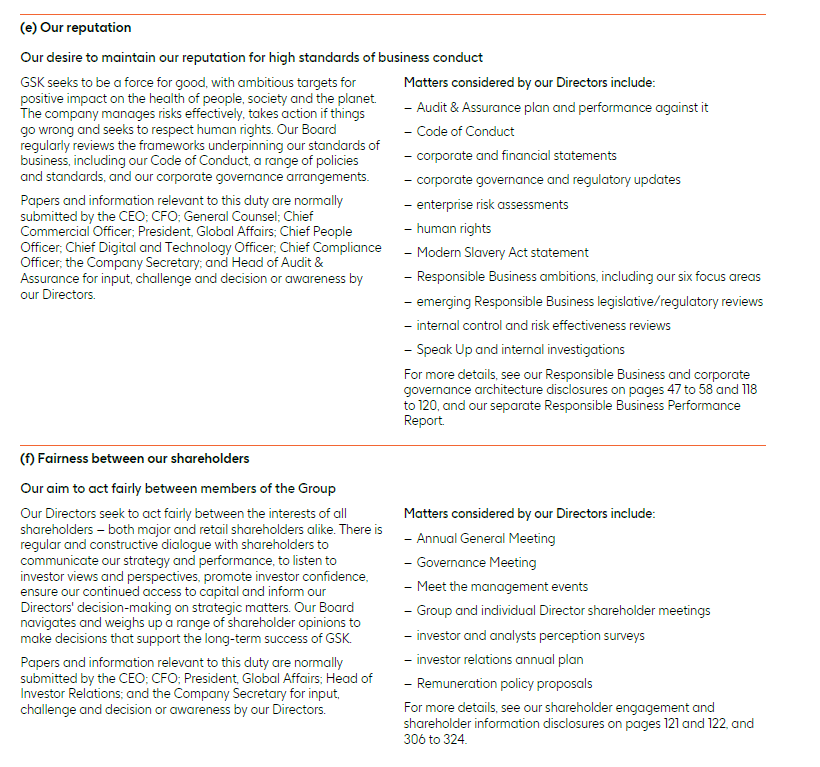
Board members are required by law to promote the success of their company for the benefit of shareholders whilst having regard for other Section 172 factors as set out below. This statement meets the requirement, as set out in Section 172 and Section 414CZA of the Companies Act 2006 (Act). It summarises how, during 2024, our Directors addressed the matters set out in Section 172(1) (a) to (f) of the Act when performing their duties.

The Board considers that this statement focuses on those risks and opportunities that are strategically important to GSK, consistent with the Group’s size and complexity. This allows it to properly understand the potential effects of the decisions it makes on all stakeholders.

The details of our engagement with the main stakeholder groups, including our patients, shareholders, consumers, customers and employees across the organisation, is summarised generally throughout the pages of our Strategic report. The Board’s continuous engagement with the company’s shareholders and people is set out on pages 125 to 132. Our corporate governance architecture and processes are summarised on pages 122 to 124. The Board seeks to consider all relevant matters when making decisions, most especially when these are to continue to drive performance and momentum for GSK into the future.

Key decisions

In its decision-making, the Board focuses on GSK’s priorities as a pure biopharma company with strong momentum and big ambitions, whilst balancing the interests of our stakeholders. Examples of some of the key decisions taken by either the Board or its Committees to drive our purpose, momentum and strategy include: