NEXT plc – Annual report – 31 January 2026
Industry: retail
SECTION 172 STATEMENT
This section describes how we have engaged with and considered the interests of our key stakeholders when exercising our duty to promote the success of the Company under section 172(1) of the Companies Act 2006. The principles underpinning section 172 are not only considered at Board level, they are embedded throughout NEXT. Sometimes decisions must be made based on competing priorities of stakeholders. In this section, we describe how the Board seeks to understand what matters to stakeholders and carefully considers all the relevant factors when selecting the appropriate course of action.
Our stakeholders
Our key stakeholder groups are set out below, with an explanation of why we have identified each as key to NEXT’s business. Our many and varied engagement processes help lead us to a better understanding of what matters to our stakeholders. Their views and needs, as well as the consequences of any decision in the long term, are then considered in the business decisions made by the Board and across the entire Company, at all levels. We do this through various methods, including: direct engagement by Board members; receiving reports and updates from members of management who engage with various stakeholders; and coverage in our Board papers of relevant stakeholder interests concerning proposed plans.
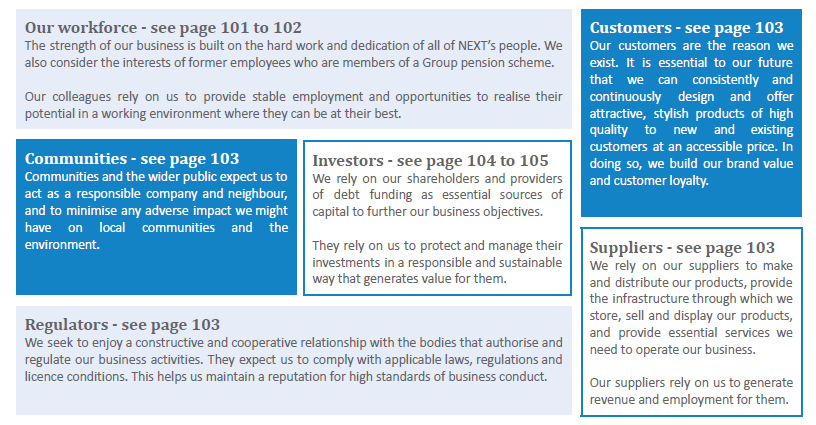
Our workforce
Our current executive directors have a combined service of close to 130 years in the NEXT Group. This gives them extensive knowledge of the business as well as an acute insight into the sentiment, culture and views of their colleagues. All of our executive directors have a high degree of personal oversight and engagement in the business. This is complemented by active engagement between our colleagues and non-executive directors and regular workforce updates to the Board, ensuring a well rounded view of the workforce. The Board also engages in the following ways:
- Annual Business Review Meetings, described further on page 102.
- Reviewing the output of employee engagement surveys and agreeing follow up actions.
- Overseeing organisational-wide talent review and development.
- Presentations on performance and business priorities from the Chief Executive and the Chief Financial Officer to our workforce following the announcements of our key trading results.
- Visits to Retail Stores and warehouses, providing an opportunity to meet a wide range of our workforce. The Board held a dedicated session at our new Thurrock store in November 2025, and spent time with employees at this store.
Business Review Meetings
The Company’s chosen workforce engagement mechanism, Business Review Meetings, provide an opportunity for employees to meet with the Board, helping them to stay connected to the direction of the Company and be involved in business decisions. During the year, Dame Tristia Harrison attended meetings along with the Chief Executive, our HR Director and workforce representatives for each division of the business. These meetings offer our employees the chance to voice their opinions on issues of importance to them. Following discussion on the key issues in different parts of the business, which included international growth, AI, cyber-security and local environment/benefits, actions were agreed and feedback was reviewed by the Board. Agreed actions from matters raised in 2025/26 included:
- Enhanced healthcare and wellbeing benefits – a new private health insurance plan has been introduced for over 5,000 of our employees.
- Developed AI guidance to improve usage across teams – this includes hints and tips to use AI in an efficient manner to avoid wastage.
Our Business Review Meetings were complemented by Your Team Voice meetings which take place regularly throughout the year. Each business function and area has a nominated Your Team Voice representative, and employees can submit questions to Business Review Meetings via Your Team Voice meetings. One purpose of Your Team Voice meetings is to agree initiatives arising from the Business Review Meetings.
Employee engagement surveys
Our Group wide employee engagement survey, ‘Your Voice Counts’, spans the majority of our business. The survey, conducted anonymously using a third-party tool, was sent to approximately 42,000 employees and the Company’s engagement score was marginally higher than the prior year. Employees identified that our main strengths as a Group are recognition for performance and championing equality and health. Wellbeing remains an area of focus for our people and we encourage our managers to make it an every day part of their role, supported by awareness campaigns and access to wellbeing resources on our dedicated intranet site, which are available to all NEXT colleagues. The Board considered the results of the survey as well as the initiatives planned to address the themes raised.
Continuous performance management and feedback
Our online performance and development tool provides a forum for positive and constructive feedback by individuals, peers and managers. Our HR Director presented at a Board meeting during the year to provide an update on employee-related matters, including workforce engagement, culture, diversity and inclusion, talent development and succession planning. This enabled the Board to consider the views and interests of employees in its discussion and decision making, consistent with the UK Corporate Governance Code requirements. The Board considers that, taken together, these arrangements deliver an effective means of ensuring the Board stays alert to the views of the workforce. With regard to health, safety and wellbeing, during the year the Audit Committee received an update on safety performance, safety risk management and mental health wellbeing initiatives.
Our relationships with suppliers, customers and others
Suppliers
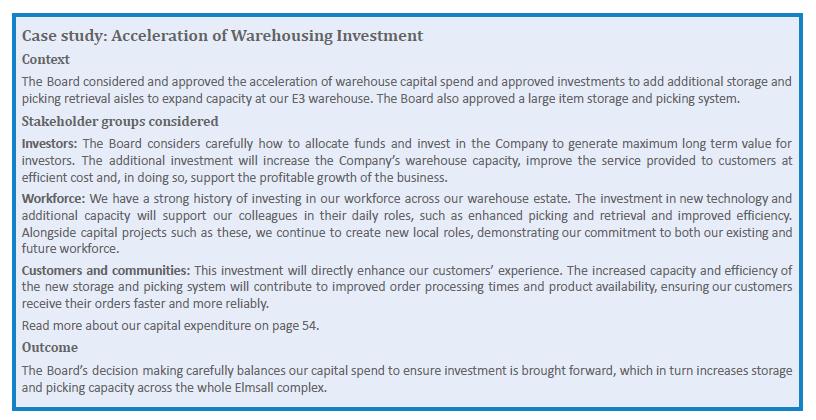
Throughout the year the Board approved major contract renegotiations and strategy with key suppliers, notably with providers of warehouse services and certain landlords. We balanced the benefits of maintaining strong partnerships with key suppliers alongside the need to obtain value for money for our investors and excellent quality and service for our customers. Further details on how we engage with our suppliers can be found on pages 94 to 95.
Customers
As a large retail business, our focus is on providing product choice, quality and value and excellent customer service for our customers. The sentiment of customers can be seen in the Company’s underlying sales performance figures, which the Board reviews regularly. The executive directors provide updates to the Board on their perceptions and the market view of consumer sentiment. The interests of customers are considered in key decisions, e.g. relating to: store portfolio changes; selection of product lines including third-party brands; selection and monitoring of suppliers to ensure quality and safety standards are met whilst also providing value; freight and logistics arrangements to maximise efficiencies from order to delivery; the availability of customer credit products; and the development of the NEXT Online platform. With the interests of customers in mind, during the year the Board reviewed proposals in respect of capital expenditure on warehouses, major freight forwarding and customer order delivery contracts and received a number of updates on the Group’s supply chain.
Regulators
The business is subject to a wide range of regulations. Of particular note is our Finance business which is authorised and regulated by the Financial Conduct Authority (FCA) in respect of the provision of consumer credit. As a responsible authorised company, we co-operate and engage constructively with the FCA and meet its standards. The Audit Committee exercises independent oversight over the regulated Finance business that includes updates on matters under discussion with the FCA.
During the year we engaged with the FCA, supporting their exploratory project looking at fees and charges in the consumer finance market, reviewing how firms are ensuring they provide fair value to their customers. We also responded to the FCA’s request to provide feedback on one of their key reporting implementations this year, the launch of product sales data information.
NEXT manages its tax affairs responsibly and proactively to comply with tax legislation. The Company’s approach is to seek to build solid and constructive working relationships with all relevant tax authorities. NEXT’s UK tax policy can be found at nextplc.co.uk and was reviewed and approved by the Board during the year. This policy outlines that the Company engages with HMRC constructively, honestly and in a timely and professional manner, and seeks to resolve disputed matters through active and transparent engagement. Engagement with HMRC is led by the Company’s in-house tax team of qualified tax professionals. The Chief Financial Officer provides regular updates to the Board on tax matters.
Debt capital/credit facility providers and credit reference agencies
The Chief Financial Officer and the Company’s Treasury team are responsible for managing the relationships with our banks, bond investors and credit rating agencies, and the management of the Group’s cash/debt and financing activities. The Chief Financial Officer provides regular reports to the Board on these activities including the Company’s access to liquidity, monitoring the headroom and maturity schedules of our primary credit facilities and future financing plans. The Board approves the Company’s Treasury Policy annually.
Our impact on the community and the environment
We have a number of targets and initiatives aimed at reducing any adverse impact of our business on the environment and the communities in which we operate. How we engage with these communities is set out in more detail on page 98 of our Group Corporate Responsibility Report.
Doing the right thing — maintaining high standards of business conduct
Corporate governance
We have a robust corporate governance framework in place, details of which are set out in our Corporate Governance Report on pages 113 to 120. The Board receives regular updates on changes to the external corporate governance landscape.
Ethical trading and responsible sourcing
The Audit Committee exercises strong oversight over the Group’s activities in these areas including reviewing the work of the Code of Practice team and receiving regular updates on Environmental, Social and Governance issues. It reports to the Board on these topics as appropriate. For further details on our approach to ethical trading and responsible sourcing, please see pages 94 to 95 as well as our Group Corporate Responsibility Report which is available on our corporate website.
Investors
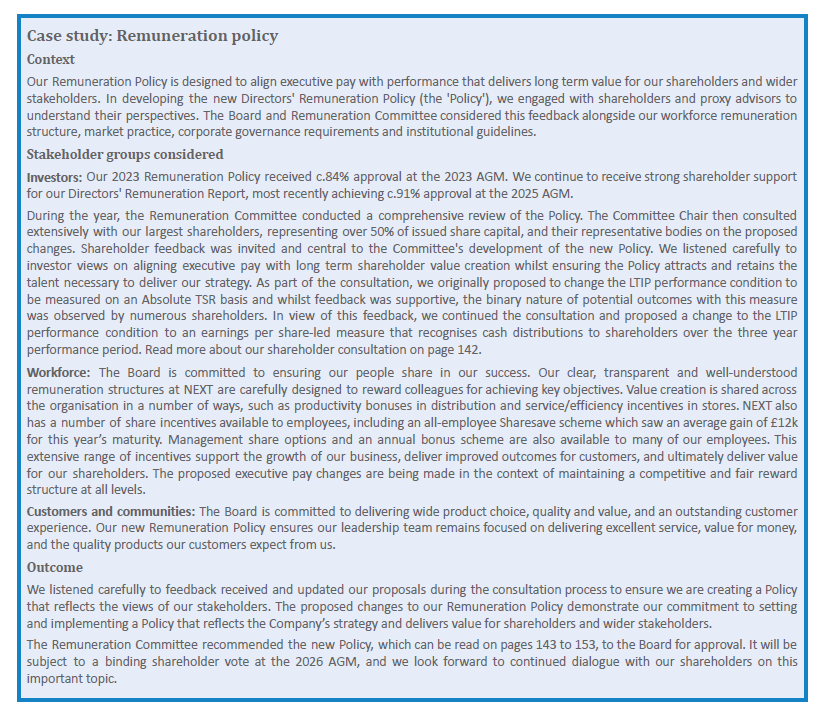
All of our shareholders benefit from the same class rights, being shareholders of ordinary shares. During the year our shareholders voted in favour of a B Share Scheme, which you can read more about in the Directors’ Report on page 170. The Board does not take any decisions or actions, such as selectively disclosing confidential or inside information, that would provide any shareholder or group of shareholders with any unfair advantage or position compared to shareholders as a whole.
How the Board engages:
- Information provided on its corporate website, such as the B Share Scheme Circular and Notice of Meeting.
- Regular calls and meetings between shareholders and the Chief Executive and Chief Financial Officer.
- Roadshows and conferences with institutional investors.
- Major shareholders are invited to the full and half year results presentations.
- Meetings and calls between major shareholders and the Chairman and Remuneration Committee Chairman on governance and remuneration matters.
- Regular communication with institutional investors by the Company Secretary and senior management, particularly on Environmental, Social and Governance matters.
- AGM.
Shareholder engagement
During the year we engaged with investors on a range of topics including:
- Governance, including Board succession and composition.
- Human rights and ethical trading.
- The environment, sustainability and responsible sourcing.
- Company performance against its business objectives.
- The Company’s approach to pay-setting, progression and development.
- Proposed Remuneration Policy – see page 142 for further details.
The Board receives regular information on investor views through a number of different channels:
- The Group’s corporate broker provides written feedback on market reaction and investor views after full and half year results announcements and investor roadshows.
- Reports from the Chairman, executive directors and non-executive directors who have direct dialogue with shareholders.
- Analyst/broker reports and views.
- Shareholder feedback reports and statements made by representative associations.
All shareholders have an opportunity to ask questions or represent their views formally to the Board at the AGM, or with directors after the meeting.
The interests of investors were considered as part of the Board’s decisions throughout the year.
Long term decisions
Within the fast-moving and seasonality of the fashion retail sector, the operational cycle is short and has become even shorter within recent years. Despite this, we are mindful that our strategic decisions can have long term implications for the business and its stakeholders and these implications are carefully assessed.
The most prevalent example of this is in the Board’s decisions with regard to capital allocation. The Board balances:
- The expectations of long term investors on dividends and the return of capital to shareholders via share buybacks and/or special dividends or by way of capital redemption; with
- The increased need for capital expenditure on warehouses, systems, stores, and our Total Platform investments to support the growth of the business.

