Diageo plc – Annual report – 30 June 2026
Industry: food and drink
Accounting information and policies (extract)
(f) Hyperinflationary accounting
The group applied hyperinflationary accounting for its operations in Türkiye and Venezuela.
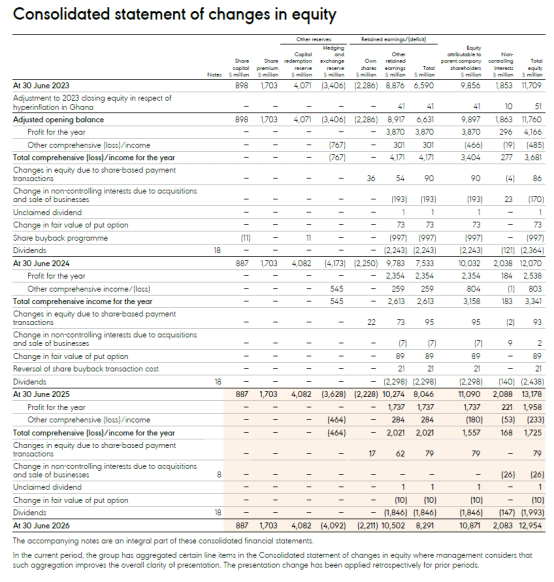
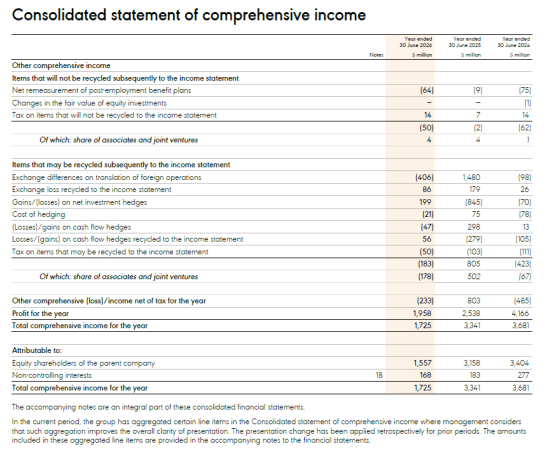
The group’s consolidated financial statements include the results and financial position of its operations in hyperinflationary economies restated to the measuring unit current at the end of each period, with hyperinflationary gains and losses in respect of monetary items being reported in finance income and charges. Comparative amounts presented in the consolidated financial statements are not restated. When applying IAS 29 on an ongoing basis, comparatives in stable currency are not restated and the effect of inflating opening net assets to the measuring unit current at the end of the reporting period is presented as part of ‘Items that may be recycled subsequently to the income statement’ in other comprehensive income, amounting to a gain of $334 million for the year ended 30 June 2026 (2025 – $264 million; 2024 – $365 million). The movement in the publicly available official price index for the year ended 30 June 2026 was 32% (2025 – 35%; 2024 – 72%) in Türkiye. The inflation rate used by the group for Venezuela is based on data of various independent valuers, as no reliable officially published rate is available. Movement in the price index for the year ended 30 June 2026 was 574% (2025 – 171%; 2024 – 77%) in Venezuela.
5. Finance income and charges
Accounting policies
Net interest includes interest income and charges in respect of financial instruments and the results of hedging transactions used to manage interest rate risk.
Finance charges directly attributable to the acquisition, construction or production of a qualifying asset, being an asset that necessarily takes a substantial period of time to get ready for its intended use or sale, are added to the cost of that asset. Borrowing costs which are not capitalised are recognised in the income statement using the effective interest method. All other finance charges are recognised primarily in the income statement in the year in which they are incurred.
Net other finance charges include items in respect of post-employment plans, the discount unwind of long-term obligations and hyperinflation charges. The results of operations in hyperinflationary economies are adjusted to reflect the changes in the purchasing power of the local currency of the entity before being translated to US dollar.
The impact of derivatives, excluding cash flow hedges that are in respect of commodity price risk management or those that are used to hedge the currency risk of highly probable future currency cash flows, is included in interest income or interest charge.
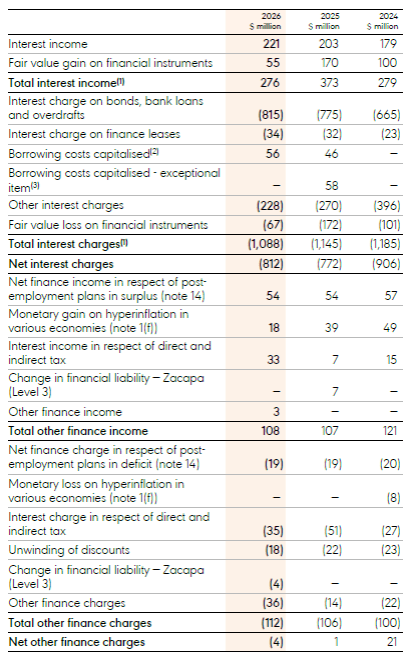
- Includes $145 million interest income and $883 million interest charge in respect of financial assets and liabilities that are not measured at fair value through profit or loss (2025 – $101 million income and $854 million charge; 2024 – $59 million income and $765 million charge).
- Forecast effective interest rate for the year of 4.0% has been used for capitalisation (2025 – 4.1%).
- Cumulative impact of prior years’ unrecognised borrowing costs reclassified to qualifying assets.