AstraZeneca PLC – Annual report – 31 December 2025
Industry: pharmaceuticals
22 Post-retirement pension and other defined benefit schemes (extract)
Financial assumptions
Qualified independent actuaries have updated the actuarial valuations under IAS 19 for the major DB plans operated by the Group to 31 December 2025. The assumptions used may not necessarily be borne out in practice, due to the inherent financial and demographic uncertainty associated with making long-term projections. These assumptions reflect the changes which have the most material impact on the results of the Group and were as follows:
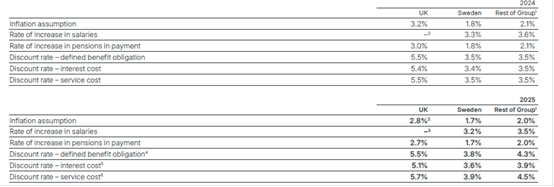
1 Rest of Group reflects the assumptions in Germany as these have the most material impact on the Group.
2 The UK inflation assumption includes an allowance for some UK inflation experience over 2025.
3 Pensionable pay frozen at 30 June 2010 levels following UK fund changes.
4 Group defined benefit obligation as at 31 December 2025 calculated using discount rates based on market conditions as at 31 December 2025.
5 2025 interest costs and service costs calculated using discount rates based on market conditions as at 31 December 2024.
The weighted average duration of the post-retirement scheme obligations is approximately 10 years in the UK, 16 years in Sweden and 12 years for the Rest of the Group (including Germany).
Demographic assumptions
The mortality assumptions are based on country-specific mortality tables. These are compared to actual experience and adjusted where sufficient data are available. Additional allowance for future improvements in life expectancy is included for all major plans where there is credible data to support a continuing trend.
The table below illustrates life expectancy assumptions at age 65 for male and female members retiring in 2025 and male and female members expected to retire in 2045 (2024: 2024 and 2044 respectively).

In the UK, the Group updated the mortality tables used, reflecting analysis carried out as part of the latest actuarial valuation and adopted the CMI Core 2024 Mortality Projections Model with core fitting parameters (H=1.0, SK=7.0), an addition to initial rates of improvement of 0.5% p.a. and a 1.0% p.a. long-term improvement rate. Other demographic assumptions were updated based on analysis carried out as part of the 2025 actuarial valuation. The Group has assumed that 15% of members (2024: 15%) will transfer out of the DB section of the UK Pension Fund at an average age of 59 (2024: 57).
In Sweden, the Group continues to use the most recently published mortality tables, DUS23, for the year.
Assets and obligations of defined benefit plans
The assets and obligations of the DB schemes operated by the Group at 31 December 2025, as calculated in accordance with IAS 19, are shown below.
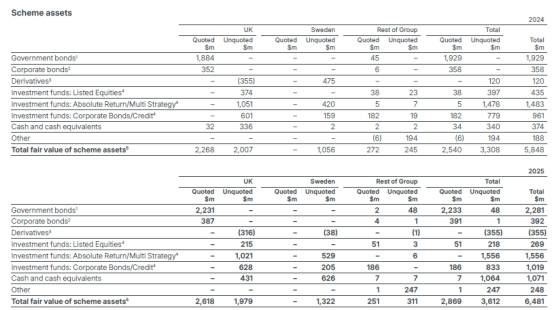
1 Predominantly developed markets in nature.
2 Predominantly developed markets in nature and investment grade (AAA-BBB).
3 Includes interest rate swaps, inflation swaps, longevity swaps, equity total return swaps and other contracts. More detail is given in the section Risks associated with the Group’s defined
benefit pension plans from page 164. Derivative fair values are determined by independent third parties.
4 Investment funds are pooled, commingled vehicles, whereby the pension plan owns units in the fund, alongside other investors. The pension plans invest in a number of investment funds, including Listed Equities (primarily developed markets with some emerging markets), Corporate Bonds/Credit (a range of investment-grade and non-investment-grade credit) and Absolute Return/Multi Strategy (actively managed multi-asset exposure both across and within traditional and alternative asset classes). The price of the funds is set by independent administrators/custodians employed by the investment managers and based on the value of the underlying assets held in the fund. Details of pricing methodology is set out within internal control reports provided for each fund. Prices are updated daily, weekly or monthly depending upon the frequency of the fund’s dealing.
5 None of the Group’s own assets were included in the scheme assets (2024: $nil).
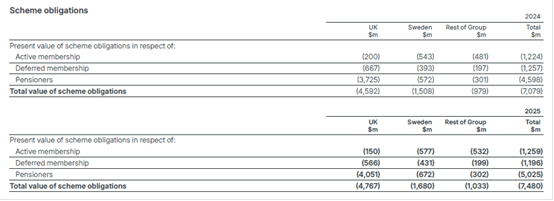
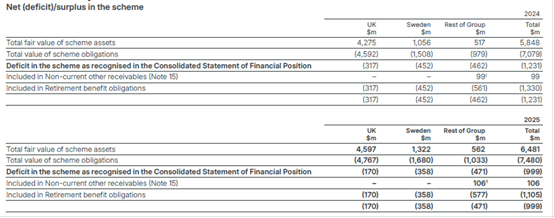
1 Surpluses were recognised in the US, Ireland and Belgium.
Fair value of scheme assets
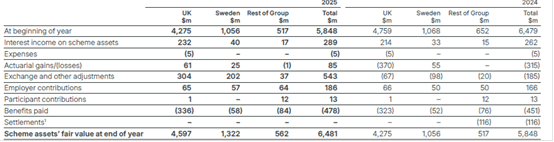
1 The 2024 settlement is the buyout of post-retirement pension plans in Norway and the Netherlands.
The actual return on the plan assets was a gain of $374m (2024: loss of $53m).
Movement in post-retirement scheme obligations
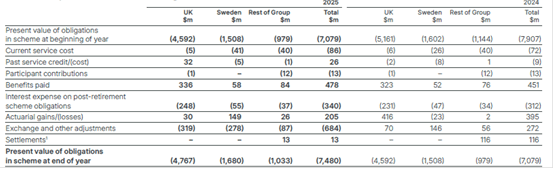
1 The 2024 settlement is the buyout of post-retirement pension plans in Norway and the Netherlands.
The obligations arise from the following plans:

1 Includes defined benefit pension schemes and other plans, such as lump sum, long-service awards and DC plans with underpins.
Consolidated Statement of Comprehensive Income disclosures
The amounts that have been charged to the Consolidated Statement of Comprehensive Income, in respect of DB schemes for the years ended 31 December 2025 and 31 December 2024, are set out below.
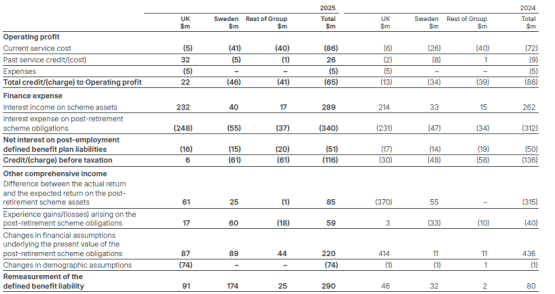
Past service cost includes granting early retirement in UK and Sweden.
Rate sensitivities
The following tables show the US dollar effect of a change in the significant actuarial assumptions used to determine the retirement benefits obligations in our two main DB pension obligation countries.
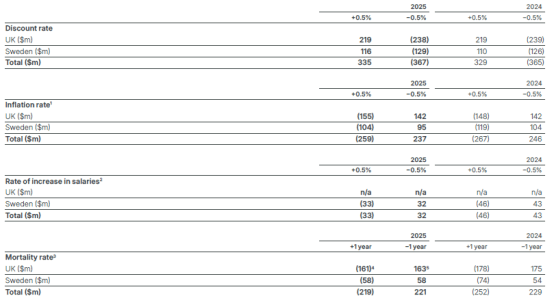
1 Rate of increase in pensions in payment follows inflation. The inflation sensitivity allows for the impact of a change in inflation on salary increases and pension increases (where these assumptions are inflation-linked).
2 The salary increase sensitivity reflects the impact of an increase of only salary relative to inflation.
3 The sensitivity to the life expectancy assumption is estimated based on a revised mortality assumption that extends/reduces the current life expectancy by one year for a particular age.
4 Of the $161m increase, $81m is covered by the longevity swap.
5 Of the $163m decrease, $81m is covered by the longevity swap.
The sensitivity to the financial assumptions shown above has been estimated taking into account the approximate duration of the liabilities and the overall profile of the plan membership.

