NEXT plc – Annual report – 27 January 2024
Industry: retail
CORPORATE RESPONSIBILITY (extract)
ENVIRONMENT
Our commitment
We are committed to minimising our environmental impact by reducing the carbon intensity of our activities and the natural resources we use.
Rankings
Our efforts around ESG are reflected in the following external benchmarks:
- Constituent of the FTSE4Good Index.
- Sustainalytics: 19.7 risk rating (low risk), ranked 298 out of 505 in our industry (retail).
- MSCI: ESG rating AA (Leader).
- CDP: Climate change: B, Forests: C, Water security: B-.
Greenhouse gas emissions – Streamlined Energy and Carbon Reporting (SECR)
In accordance with the disclosure requirements for listed companies under the Companies Act 2006, the table below shows the Group’s SECR disclosure across Scope 1 and 2 together with an appropriate intensity metric and our total energy use of gas, electricity and other fuels during the financial year. The reported emissions data includes NEXT plc and those of its subsidiaries in which it has a controlling interest. Emissions from newly acquired subsidiaries will be consolidated in our reporting when reliable and accurate data is evidenced, with the aim to report in the first full year post acquisition. As such, the table below does not include FatFace, however in relation to Reiss which is otherwise excluded, it does include owned distribution vehicles for Scope 1 which sit within NEXT’s own data from when Reiss became a TP partner and NEXT distribution was used.
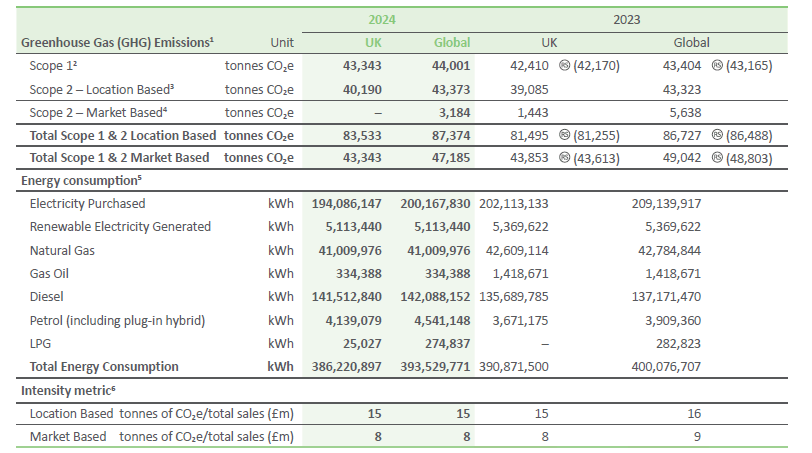
1. The methodology used to calculate our emissions aligns with our global direct carbon footprint and is measured in alignment with the GHG Protocol Corporate Accounting and Reporting Standard and RE100 reporting parameters. We adopt the conventional approach in calculating our carbon emissions through the collection of primary, secondary, or tertiary data in their source units (e.g. kilowatt-hours (kWh), litres (L), kilograms (kg), kilometres (km) etc.). The consumption figures relating to each energy source are converted into carbon emissions by applying the relevant carbon conversion factor. Factors are updated annually using the most recent factors published by the UK Department for Energy Security and Net Zero (DESNZ) and the UK Department for Environment, Food and Rural Affairs (DEFRA); 2023 is the most recent accessible update.
2. Scope 1 being emissions from combustion of fuel and refrigerant gas losses.
3. Scope 2 being electricity (from location based calculations), heat, steam and cooling purchased for the Group’s own use (excluding FatFace and Reiss).
4. The calculation of market based emissions is based on our energy suppliers fulfilling their contractual obligations under the terms of renewable tariffs to back all energy supplied to all of their customers on such tariffs. As members of RE100, our approach is informed by the RE100 quality criteria and GHG protocol guidance. RE100 requires claims to use of renewable electricity to be based on generation occurring in the same market for renewable electricity that use is claimed in, this includes the single market in Europe. The revised RE guidance published in December 2022 provided an updated list of countries that make up the single market. Although the UK has been excluded from the list, the RE guidance provided grandfathering provisions for contracts with operational commencement dates before 1 January 2024, allowing for the UK to continue to be recognised within the single market in Europe. The operational commencement dates of our contracts occurred prior to 1 January 2024, therefore we have applied the grandfathering provisions when calculating our market based emissions.
5. Energy from electricity, natural gas, gas oil, transport fuel and LPG have been included. We have used the conversion factors published in 2023 DEFRA GHG conversion factors for company reporting to convert from passenger miles in company-owned vehicles to kWh.
6. We use tonnes of CO2e/Total Sales (£m) as our intensity metric. Sales for Reiss and FatFace have been excluded as they were acquired part way through the year.
RS Restated from prior year due to the incorrect application of the conversion factor used to convert the raw data into tCO2e resulting in an understatement of the balance in the prior year.
This changed the emissions for NEXT owned cars from 1,450 to 1,690 which is above our 5% materiality threshold for restatement. This category of Scope 1 emissions sits across multiple data lines in the table, causing multiple numbers to be restated.
Changes in our SECR
The main cause of our Scope 1 emissions increasing is a greater usage of our own vehicles for distribution. This is in context of business growth, demonstrated by NEXT Trading Total Sales growth of +3%.
Energy consumption data is captured through monthly bills showing actual or estimated consumption. We continue to look for ways to improve energy efficiency as this reduces both carbon emissions and costs for our business. We actively track and review energy performance via a central data collection facility to ensure our properties are operating efficiently. The following initiatives were undertaken during the year:
- Continued to invest in high efficiency LED lighting which are now in 90% of our retail stores. This reduced our lighting energy consumption by around 75% in comparison to the lighting replaced. The LED lighting solutions are fitted in new stores as standard. At the end of the year we had refitted 418 out of 464 NEXT stores, and aim to have the balance of stores’ lighting replaced by the end of March 2024.
- Solar panel installation is complete at our Elmsall 3 warehouse. The renewable electricity generated across all our sites in the year was 5.1m KwH, an increase of approximately 1.5m KwH on last year.
- Maintained our Energy Forums, working closely with our energy provider and other parties to actively identify opportunities in energy efficiency measures and technology to help reduce our environmental impact and deliver savings for the business.
- We are agreeing a Power Purchase Agreement for longer term commitment to renewable energy usage. Under the agreement we will obtain 13% of our annual energy requirement for 15 years, starting in October 2024.
Renewable energy
NEXT is a signatory to the RE100 initiative and has committed to using 100% renewable energy by 2030. Our UK and Eire operations have been run using 100% renewable energy since April 2017 and we continue to work towards achieving this target in our direct operations overseas.
Carbon footprint – including Scope 3
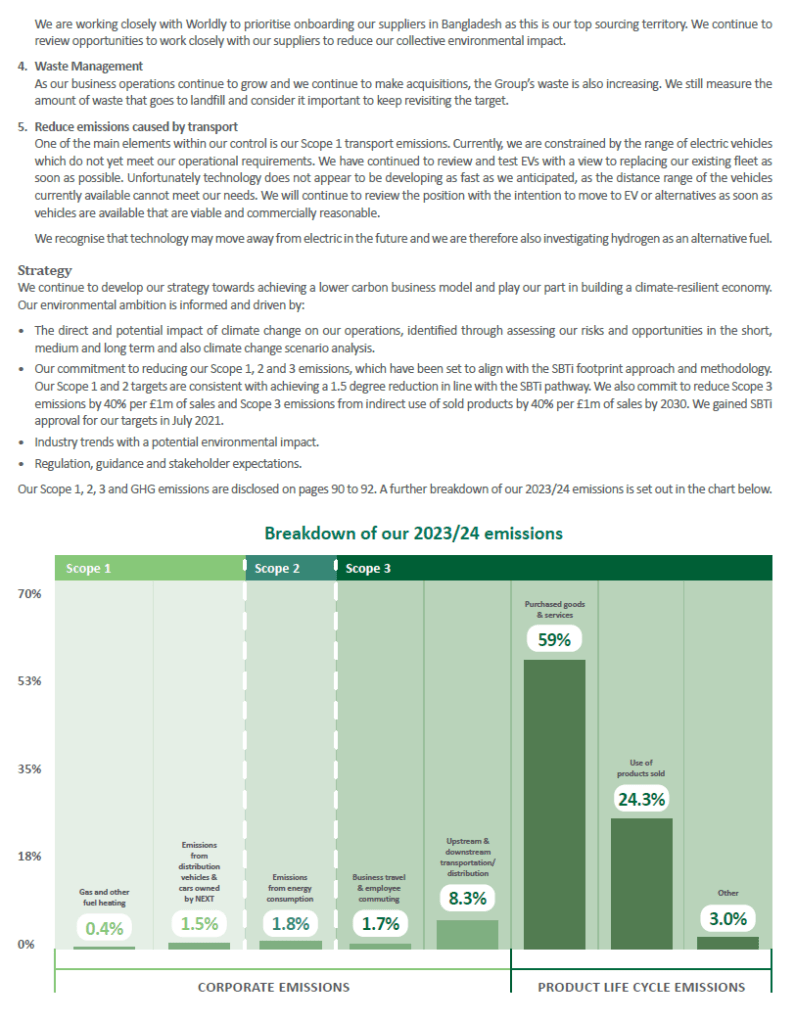
Due to the nature of our business, most of our carbon footprint falls outside of our direct control and is reported under our Scope 3 emissions. Our Scope 3 total emissions disclosure (CO2e) covers the complete lifecycle of all the products we sell, including branded items sold through LABEL and Total Platform. As FatFace had not yet transitioned into our warehouse for this reporting period, only sales of their products through LABEL is included. This extends from the production of raw materials through to the manufacture, transport, how our customers use and care for them and the eventual end of life treatment of the products we sell. The emissions have been estimated in line with the GHG Protocol Corporate Accounting and Reporting Standard and are based on a combination of internal data coupled with the best available public sources on CO2 emissions factors using conservative assumptions.
Our total Scope 3 emissions are reported in the table below, together with our Scope 1 and 2 (location based) emissions. Our carbon reduction targets are set out on page 98.

1. The methodology used to calculate our emissions is set out in our Corporate Responsibility Report which can be found on our corporate website at nextplc.co.uk. It does not include FatFace and includes Reiss in relation to Scope 1 owned distribution vehicles which sit within NEXT’s own data and Scope 3 for Reiss product that travelled through our warehouse as a result of being a TP client.
2. Restated from prior year due to the incorrect application of the conversion factor used to convert the raw data into tCO2e, resulting in understatement of the balance in the prior year.
3. We have excluded franchises from our reporting boundary at present due to challenges in obtaining accurate and reliable data.
RS Restated from prior year.
Changes in our GHG Scope 3 emissions
Our Scope 3 increases have been driven by an increase in air freight within our distribution; increased business travel now that this is possible post-COVID; and purchased goods for acquisitions including Joules and Reiss. Purchased Goods remains to be the biggest category of impact. We have
rolled out a live ‘Responsible Sourcing Progress Report’ internally, which gives the commercial buying teams the ability to review their progress on a weekly basis without the need to wait for a formal report. This also encourages collaboration between teams to drive progress and to identify implementation challenges. We continue to focus on uptake of more responsible materials whilst we are gathering data from our supply chain to understand where we can best support energy reduction.
Task Force on Climate-Related Financial Disclosures (TCFD)

NEXT recognises that climate change poses challenges for our business and supply chain. We are looking at the ways in which we can best support the Paris Agreement on climate to limit the rise in global temperatures to well below 2⁰C. Accurate and relevant disclosures are essential to demonstrate progress and ensure stakeholder accountability. Whilst reporting frameworks surrounding sustainability are still being developed and are evolving, reporting helps us set a baseline from which appropriate and meaningful actions can be taken.
Statement of compliance
NEXT’s climate-related disclosures are consistent with the recommendations and recommended disclosures set out in ‘Section C – All Sector Guidance’ within the Supplementary Guidance Report ‘Implementing the Recommendations of the Task Force on Climate-related Financial Disclosures’ published in 2021 of the TCFD, and in compliance with the requirements of LR 9.8.6R (UK Listing Rules). These disclosures set out how NEXT incorporates climate-related risks and opportunities into governance, strategy, risk management, what we are doing to reduce our environmental impact and our key metrics and targets.
1. Governance – Disclose the organisation’s governance around climate-related risks and opportunities
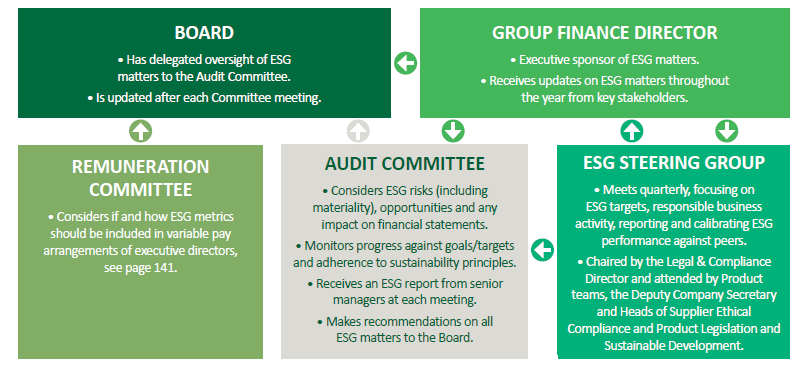
Our governance structure around ESG-related activities is relatively simple. This allows emerging issues and matters for decisions to be escalated quickly.




 Accounts examples