NEXT plc – Annual report – 27 January 2024
Industry: retail
SECTION 172 STATEMENT
This section describes how we have engaged with and considered the interests of our key stakeholders when exercising our duty to promote the success of the Company under section 172(1) of the Companies Act 2006. The principles underpinning section 172 are not only considered at Board level, they are embedded throughout NEXT. Sometimes decisions must be made based on competing priorities of stakeholders. We describe below how the Board seeks to understand what matters to stakeholders and carefully considers all the relevant factors when selecting the appropriate course of action.
Our stakeholders
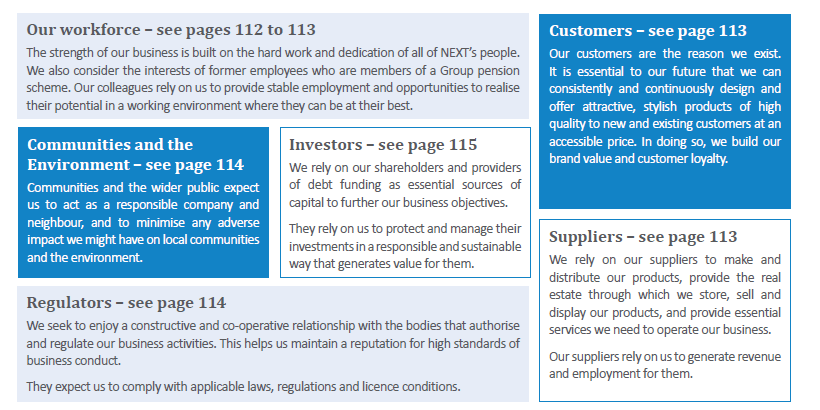
Our key stakeholder groups are set out below, with an explanation of why we have identified each as key to NEXT’s business. Our many and varied engagement processes help lead us to a better understanding of what matters to our stakeholders. Their views and needs, as well as the consequences of any decision in the long term, are then considered in the business decisions made by the Board and across the entire Company, at all levels. We do this through various methods, including: direct engagement by Board members; receiving reports and updates from members of management who engage with various stakeholders; and coverage in our Board papers of relevant stakeholder interests with regard to proposed plans.
Our workforce
Our current executive directors have a combined services of over 140 years in the NEXT Group. This gives them extensive knowledge of the business as well as an acute insight into the mood, culture and views of their colleagues. All of our executive directors have a high degree of personal oversight and engagement in the business. The Board also engages in the following ways:
- Annual Business Review Meetings, described further on page 113.
- Discussing the output of employee engagement surveys and agreeing follow up actions.
- Presentations on performance and strategy from the Chief Executive and the Group Finance Director to our workforce following the announcements of our key trading results. Where possible, the directors present to the business in person, but a video link is sent to remote employees.
- Visits to stores and warehouses, providing an opportunity to meet a wide range of our workforce.
- Online performance, development and feedback tools.
Engagement with our employees has always been vital to the success of our business. We continued to engage with our workforce about their health and safety.
Business Review Meetings
This was our second year of Business Review Meetings, which replaced our annual Recruit, Reward and Retain (RRR) workforce forums. These meetings form the workforce advisory panels as referred to in the UK Corporate Governance Code and focus on specific business outputs such as efficiencies and ideas to improve engagement. Dame Dianne Thompson, one of our non-executive directors, attended the meetings along with the Chief Executive, our HR Director and workforce representatives for each division of the business. These meetings offer our employees the chance to voice their opinions on the issues that are important to them. Following discussion on the key issues in different parts of the business, actions were agreed and feedback was reviewed by the Board.
Agreed actions from matters raised in 2023 included:
- Further training on handling challenging customers safely and increasing the visibility and impact of our ‘Respect in Retail’ initiative.
- Reviewing the questions of employee engagement survey to elicit responses to which management are able to take action, as well as providing additional support to management to enable them to respond to comments.
Our Business Review Meetings were supplemented by Your Team Voice meetings which take place regularly throughout the year. Each business function and area has a nominated Your Team Voice representative, and employees are able to submit questions to Business Review Meetings via Your Team Voice meetings. One purpose of Your Team Voice meetings is to agree initiatives coming out of the Business Review Meetings.
Employee engagement surveys
In 2023, we undertook our third Group wide employee engagement survey, ‘Your Voice Counts’, which spanned the majority of our business. The survey was sent to almost 42,000 employees and response rates were improved from the year before. The survey was conducted anonymously using a third-party tool. The overall engagement score for the whole NEXT Group was slightly higher than our score in 2022.
Employees believe that our main strengths as a Group are: recognition for performance and organisational fit, highlighting equality and health. Areas identified for improvement included transparency on career paths for development and progression.
The Board considered results of the survey as well as the initiatives planned to address the matters raised.
Continuous performance management and feedback
Our online performance and development tool provides a forum for positive and constructive feedback by individuals, peers and managers.
Our HR Director attended a meeting of the Board to brief the directors on employee-related matters, including workforce demographics, engagement activities, the results of employee engagement survey, staff retention rates, diversity, whistleblowing, disciplinary and grievance procedures, learning and development activity, pay and reward including gender pay gap and HR initiatives.
The Board considers that, taken together, these arrangements deliver an effective means of ensuring the Board stays alert to the views of the workforce.
With regard to health, safety and wellbeing, during the year the Audit Committee received an update from the Group Health and Safety Manager on safety performance, safety risk management and mental health wellbeing initiatives.
Our relationships with suppliers, customers and others
Suppliers
Throughout the year the Board approved major contract renegotiations and strategy with key suppliers, notably with the Group’s lender for the revolving credit facility, providers of freight forwarding services and certain landlords. We balanced the benefits of maintaining strong partnerships with key suppliers alongside the need to obtain value for money for our investors and excellent quality and service for our customers. Further details on how we engage with our suppliers can be found on pages 104 to 105.
Customers
As a large retail business, the sentiment of customers can be seen in the Company’s underlying sales performance figures, which the Board reviews regularly. The executive directors provide updates to the Board on their perceptions and the market view of consumer sentiment. The interests of customers are considered in key decisions, e.g. relating to: store portfolio changes; selection of product lines including third-party brands; selection and monitoring of suppliers to ensure quality and safety standards are met; freight and logistics arrangements to maximise efficiencies from order to delivery; the availability of customer credit products; and the development of the NEXT Online platform.
With the interests of customers in mind, during the year the Board reviewed proposals in respect of capital expenditure on warehouses, major freight forwarding and customer order delivery contracts.
Regulators
The business is subject to a wide range of regulations. Of particular note is our Finance business which is regulated by the Financial Conduct Authority (FCA) in respect of the provision of consumer credit. As a responsible authorised company, we seek always to co-operate and engage constructively with the FCA and meet its standards. The Audit Committee exercises independent oversight over the regulated Finance business that includes updates on matters under discussion with the FCA.
During the year we engaged with the FCA’s market study on how ‘Buy Now, Pay Later’ products are sold and how customers benefit from such products. This included sharing information on the forbearance measures we offer to customers in financial difficulties. We have also responded to regulatory consultations to help the FCA inform and shape future regulation and consumer support in areas such as cost of living, complaint handling and affordability.
NEXT manages its tax affairs responsibly and proactively to comply with tax legislation. The Company’s approach is to seek to build solid and constructive working relationships with all tax authorities. NEXT’s UK tax policy can be found at nextplc.co.uk and was reviewed and approved by the Board during the year. This policy includes that the Company engages with HMRC constructively, honestly and in a timely and professional manner, and seeks to resolve disputed matters through active and transparent engagement. Engagement with HMRC is led by the Company’s in-house tax team of qualified tax professionals. The Group Finance Director provides regular updates to the Board on tax matters.
Debt capital/credit facility providers and credit reference agencies
The Group Finance Director and the Company’s Treasury team are responsible for managing the relationships with our banks, bond investors and credit rating agencies, and the management of the Group’s cash/debt and financing activities. The Group Finance Director provides regular reports to the Board on these activities including the Company’s access to liquidity, monitoring the headroom and maturity schedules of our primary credit facilities and future financing plans. The Board approves the Company’s Treasury Policy annually.
Case study: regulator
In February 2023, as part of their assessment of the industry’s readiness for the implementation of Consumer Duty, the FCA invited a number of firms to provide details of how they were planning to ensure that their products offered fair value to customers – one of the four key outcomes of the Duty.
NEXT was selected for further engagement and we provided our framework for reviewing our existing products, including the process, methodology and the data utilised to make our fair value assessments. The feedback from FCA was positive and helped to conclude our readiness to ensure all of our Consumer Duty obligations are being met. The Audit Committee and the Board maintained oversight of the engagement via regular meeting updates and provided input to management to shape the engagement approach.
Our impact on the community and the environment
We have a number of targets and initiatives aimed at reducing any adverse impact of our business on the environment and the communities in which we operate. The ways in which we engage with these communities are set out in more detail on page 108 of our Corporate Responsibility Report. During the year we considered our approach to climate change and agreed further measures we can take to reduce our impact on the environment. Details can be found on pages 90 to 101 of the Corporate Responsibility Report.
Doing the right thing – maintaining high standards of business conduct
Corporate governance
We have a robust corporate governance framework in place, details of which are set out in our Corporate Governance Report on pages 123 to 129.
Ethical trading and responsible sourcing
The Audit Committee exercises strong oversight over the Group’s activities in these areas including reviewing the work of the Code of Practice team and receiving regular updates on Environmental, Social and Governance issues. It reports to the Board on these topics as appropriate. For further details on our approach to ethical trading and responsible sourcing, please see pages 104 to 105 as well as our Corporate Responsibility Report which is available on our corporate website.
Political donations
No donations were made for political purposes (2023: £nil).
Investors
The Company has just one class of share in issue and so all shareholders benefit from the same rights. The Board does not take any decisions or actions, such as selectively disclosing confidential or inside information, that would provide any shareholder or group of shareholders with any unfair advantage or position compared to shareholders as a whole.
How the Board engages:
- Regular calls and meetings between shareholders and the Chief Executive and Group Finance Director.
- Roadshows and conferences with institutional investors.
- Major shareholders are invited to the annual and half year results presentations.
- Meetings and calls between major shareholders and the Chairman and Remuneration Committee Chairman on governance and remuneration matters.
- Regular communication with institutional investors by the Company Secretary and senior management, particularly on Environmental, Social and Governance matters.
Shareholder engagement
During 2023 we engaged with investors on a range of topics including:
- Governance including Board composition.
- Human rights and ethical trading.
- The environment, sustainability and responsible sourcing.
- Company performance against its strategy.
- Our 2023 AGM results – see page 125 for further details.
The Board receives regular information on investor views through a number of different channels:
- The Group’s corporate broker provides written feedback on market reaction and investor views after full and half year results announcements and investor roadshows.
- Reports from the Chairman and other non-executive directors who have direct dialogue with shareholders.
- Analyst/broker reports and views.
- Shareholder feedback reports and statements made by representative associations.
All shareholders have an opportunity to ask questions or represent their views formally to the Board at the AGM, or with directors after the meeting.
The interests of investors were considered as part of the Board’s decisions throughout the year.
Long term decisions
Within the fast-moving fashion retail sector, the operational cycle is short and has become even shorter within recent years. Despite this, we are mindful that our strategic decisions can have long term implications for the business and its stakeholders and these implications are carefully assessed.
The most prevalent example of this is in the Board’s decisions with regard to capital allocation. The Board balances:
- The expectations of long term investors on dividends and the return of capital to shareholders via the share buyback programme; with
- The increased need for capital expenditure on warehouses, systems, stores, and our Total Platform investments to support the growth of the business.
 Accounts examples