Rakuten, Inc. – Annual report – 31 December 2024
Industry: financial, technology
2. Material Accounting Policies (extract)
(15) Revenue
The Rakuten Group recognizes revenue based on the below five-step approach, reflecting the amount of consideration expected to be entitled to in exchange for transferring goods or services to customers, excluding interest and dividend income under IFRS 9 “Financial Instruments” (hereinafter “IFRS 9”), lease income under IFRS 16 “Leases”, and insurance premium income under IFRS 17.
Step 1: Identify the contract with a customer.
Step 2: Identify the performance obligations in the contract.
Step 3: Determine the transaction price.
Step 4: Allocate the transaction price to the distinct performance obligations in the contract.
Step 5: Recognize revenue when (or as) a performance obligation is satisfied.
The Rakuten Group is a Global Innovation Company engaged in Internet Services, FinTech, and Mobile, operating in multiple businesses including its core EC business. Revenues arising from these businesses are recognized based on contracts with customers. There are no material revenues which are subject to variable consideration. In addition, the amount of promised consideration does not include significant financial elements.
(Internet Services)
With regard to the Internet Services segment, the Rakuten Group engages in EC businesses such as “Rakuten Ichiba”, “Rakuten Travel”, “Rakuten Rewards”, “Rakuten 24”, “Rakuten Books” and a variety of other internet businesses. The primary revenues in the Internet Services segment are described below.
Rakuten Ichiba and Rakuten Travel
A fundamental characteristic of marketplace model EC services including “Rakuten Ichiba” and travel booking services such as Rakuten Travel is to provide EC platforms for trading to customers, and the Rakuten Group provides merchants and travel-related businesses with services including EC platform services, transaction related services, advertising related services to promote the expansion of sales through the Rakuten Group, and payment agency services related to settlements between merchants or travel-related businesses and consumers. The nature of the services and the related rights and obligations are stipulated in various agreements with customers. Performance obligations are identified based on whether services are distinct or not, and the pattern of transfer to the customer. Revenues from major performance obligations are recognized as described below.
With regard to EC platform services to “Rakuten Ichiba”, the Rakuten Group has obligations to provide services for merchants to open and operate on our EC platform and related consulting services and other similar services for a contracted term. These services are provided over time, and so these performance obligations are satisfied as time passes. Accordingly, the revenue is recognized over the contracted term on a monthly basis based on the amount stipulated in the agreement for each type of shop. Furthermore, consideration for a transaction is received at the time of contract in the form of advance payment for the period of three months, six months or one year, prior to the satisfaction of performance obligations.
The Rakuten Group has obligations based on agreed terms to provide services to match merchants and travel-related businesses with Rakuten users, and to enable the resultant transactions to be processed appropriately. These performance obligations are satisfied when the individual transaction between merchants or travel-related businesses and Rakuten users is completed. Revenues are recognized at the point of satisfaction of these performance obligations, based on the gross amount of merchandise sales (monthly sales of merchants and travel-related businesses) of completed transactions multiplied by the specified ratio stipulated separately for each service, plan, or amount of gross merchandise sales. The related payments are receivable approximately within three months of the completion of the transaction.
With regard to advertising-related services, the Rakuten Group has obligations to provide fixed-term advertisements to customers. The advertising related services are provided by displaying the advertisement over the contracted term, and the progress of providing the service is measured based on the passage of time. Therefore, performance obligations are satisfied over the contract term, and revenues are recognized evenly over the contract term according to the amount stipulated in the agreement for each type of advertisement. Advertising fees are, in principle, received by the end of the second subsequent month after the month that includes the advertising commencement date.
With regard to payment agency services, the Rakuten Group has obligations to provide payment agency services based on payment agent agreements between merchants and travel-related businesses. The Rakuten Group has obligations to receive payments for the transactions from credit card companies, etc., and to pay settlement amounts to merchants and travel-related businesses. Commission revenues arising from these transactions are primarily recognized when the transactions subject to payment are completed, as the performance obligations are considered to be satisfied at that point. Commissions are received within one month and a half after the cut-off date for invoices set out for each payment category, following the satisfaction of performance obligations.
Rakuten Rewards
“Rakuten Rewards” provides various services such as services for promoting Rakuten Rewards members’ purchase at the websites of the retailers (customers) through offering cash back services, web advertising and targeting mail services for individual consumers. Rakuten Rewards is contractually obligated to promote purchases at the retailers’ websites. Thus, such performance obligations are considered to be satisfied at the point of purchase by Rakuten Rewards members. Upon confirmation of the purchase by a Rakuten Rewards member, an amount calculated by multiplying the purchase amount by a certain rate is recorded as commission revenue. Expenses relating to the promotion to the Rakuten Rewards member are recorded as cost of sales at the point of purchase by the Rakuten Rewards member. Revenue and expense arising from the provision of this service are recorded on a gross basis, as “Rakuten Rewards” has the right to enforce discretionary control over the setting of rates for commissions earned from customers and also has separate discretionary control over the setting of prices in relation to promotion services to Rakuten Rewards members in each transaction. Payments of fees are received approximately within three months from the end of the month in which the order is completed and performance obligations are satisfied.
Rakuten 24, Rakuten Books
In the Internet Services segment, the Rakuten Group is the principal in the sales contracts for services including internet shopping sites “Rakuten 24” and “Rakuten Books” where the Rakuten Group offers products to Rakuten users. In these direct selling services, revenue is recognized when goods are delivered to the customer. In addition, payments are received approximately within two months after the delivery of goods when performance obligations are satisfied. For book (Japanese book) sales in Japan through Rakuten Books, revenues are recognized on a net basis after deducting costs of sales, because the role of the Rakuten Group in these transactions has the nature of an agent given the resale price maintenance system in Japan.
(FinTech)
With regard to the FinTech segment, the Rakuten Group engages in financial services businesses such as “Rakuten Card”, “Rakuten Securities” and “Rakuten Bank”, recognizing revenues primarily as follows:
Rakuten Card
“Rakuten Card” engages in the credit card business, and receives interchange fees for settlement services between credit card users and member merchants as well as, revolving payment commissions, installment commissions, and commissions arising from cash advances. With regard to interchange fees, the performance obligation, which is the provision of settlement services, is satisfied at the time of the sales data transfer from a member merchant to Rakuten Card Co., Ltd. as a result of a credit card purchase. Therefore, commission revenues which are at fixed rates of the settlement amounts are recognized at that point in time. In addition, basic points worth 1% of the settlement amounts are granted to the card members, and the expenses associated with the granting of these points are deducted from the interchange fees. As Rakuten Card Co., Ltd. collects credit card payments from the card members once a month, in principle, on a predetermined date, the payments are in substance received approximately within two months after the satisfaction of the performance obligations. For revolving payment commissions, installment commissions and commissions for cash advances, the respective commissions, which are at fixed rates of the number of payment installments on the balance are recognized as a revenue over the period when the interest accrues in accordance with IFRS 9.
Rakuten Securities
“Rakuten Securities” engages in financial instruments transaction services and other associated services. Sources of revenue include commissions arising from these transactions, net trading gains, and interest, etc. There is a wide range of financial instruments transactions, including domestic stock transactions, foreign stock transactions, sales of investments, and the commission structure for each transaction differs. For these transactions, margin transactions and sales of investment trusts, performance obligations are satisfied when trades are completed on the trade date or other appropriate date, therefore commission revenues arising from brokerage transactions are recognized at that point in time. Commissions from spot transactions of shares are received within two business days in principle after the satisfaction of the performance obligations, while commissions from margin transactions and future transactions are received approximately within the period from six months to one year during which open contracts are settled. Rakuten Securities records net revenue based on fair value of foreign exchange margin transactions, and income received on open contracts of domestic stock margin transactions, in accordance with IFRS 9.
Rakuten Bank
“Rakuten Bank” provides a wide range of services including internet banking (deposits, loans and foreign exchange) and other services. With regard to loans, Rakuten Bank handles loans such as personal loans, “Rakuten Bank Super Loans,” and housing loans, “Rakuten Bank home loans (flexible interest rate)” and earns interest income thereon. Interest income is also earned from investing activities such as interest on securities. This income, such as loan interest and interest earned on securities are recognized over the period in accordance with IFRS 9. With regard to foreign exchange, commission revenue is recognized when the foreign exchange transactions are executed because the performance obligation is satisfied at the point of processing the transaction. Payments related to exchange fees, etc. are received mainly on the same day.
(Mobile)
With regard to the Mobile segment, the Rakuten Group engages in businesses such as “Rakuten Mobile”, “Rakuten Symphony” and “Rakuten Energy” recognizing revenues primarily as follows:
Rakuten Mobile
“Rakuten Mobile” is mainly engaged in the provision of voice calling and data transmission services (hereinafter “telephone and telecommunications services”) and sales of mobile handsets as a Mobile Network Operator (MNO) and Mobile Virtual Network Operator (MVNO). For telephone and telecommunications services, maintaining utilizable telephone and telecommunications circuits for users at all times and providing the services using such circuits based on contracts are identified as performance obligations. For handset sales, delivery of the handset is identified as a performance obligation. When multiple services are provided in a single package, the consideration received from users is divided by the stand-alone selling price and allocated to each performance obligation. The performance obligation for maintaining utilizable telephone and telecommunications circuits is satisfied over the period, and the performance obligation for providing the telephone and telecommunications services is satisfied when the circuits are utilized. Therefore, revenues arising from providing the circuits are recognized over the contract term. For provision of telephone and telecommunications services, connection fees according to the actual usage of the circuits are recognized on a monthly basis. For handset sales, the performance obligation is satisfied when a mobile handset is delivered to the user, and thus related revenues are recognized at that point. Payments for all performance obligations are received approximately within two months from the billing date.
Rakuten Symphony Singapore
Rakuten Symphony Singapore Pte. Ltd. engages in the sale of an Open RAN-based communication infrastructure platform and the provision of related services. With regard to this service, based on the contract, the performance obligations are recognized as selling equipment and software developed by our group companies to customers, as well as providing maintenance and operational services for the said software. Regarding the sale of equipment and software, revenue is recognized upon completion of customer acceptance, as the performance obligation is fulfilled at that point. The maintenance and operational services for the software include routine services and specific support services. Regarding routine services, revenue is recognized throughout the service period, as the performance obligation is fulfilled over time. Regarding specific support services, revenue is recognized at the point when the service provision to the customer is completed in accordance with the contract. Payments for all performance obligations are generally received within one month from the billing date.
Rakuten Energy
“Rakuten Energy” provides “Rakuten Denki” services as a retail electricity provider under the Electricity Business Act, and is obligated to sell electricity to subscribers, its customers, based on the contracts. Such performance obligations are considered to be satisfied when the electricity procured is supplied to customers via general transmission and distribution companies, etc. Accordingly, electricity usage fees based on customers’ electricity usage are recorded as revenue for each month. An amount mainly calculated by multiplying the amount of electricity used by the regional unit price set for each plan is billed to subscribers on a monthly basis, and such payments are received approximately within two months from the date of billing. The renewable energy generation promotion levy, which is collected from customers and paid to the expense sharing coordinating body under the feed-in tariff system for renewable energy, is excluded from both sales and cost of sales.
Government grants received under the “Electricity and Gas Price Dramatic Change Mitigation Measures Project” (effective from January 2023), a policy based on the “Comprehensive Economic Measures for Overcoming Price Increases and Revitalizing the Economy”, which the Japanese government is implementing amid COVID-19, are treated in accordance with IAS 20 “Accounting for Government Grants and Disclosure of Government Assistance” (hereinafter “IAS 20”) and included in revenue. In addition, all amounts of the government grants received are reflected appropriately on a retail rate in accordance with the objective of the project.
(16) Contract Costs
The Rakuten Group recognizes the incremental costs of obtaining contracts with customers and the costs incurred in fulfilling contracts with customers that are directly associated with the contract as an asset (hereinafter “assets arising from contract costs”), if those costs are expected to be recoverable and record them in “Other assets” in the Consolidated Statement of Financial Position. Incremental costs of obtaining contracts are those costs that the Rakuten Group incur to obtain a contract with a customer that would not have been incurred if the contract had not been obtained.
Assets arising from contract costs at the Rakuten Group are recognized primarily at “Rakuten Card” and “Rakuten Mobile”, and are regularly reviewed for recoverability at the time of recognition and each quarter end.
The estimates and assumptions used in considering the recoverability could have a significant impact on the amount of assets arising from contract costs recorded through the recognition of impairment losses when circumstances change. Therefore, the Rakuten Group considers that these estimates and assumptions are significant.
Rakuten Card
Incremental costs of obtaining contracts recognized as assets are mainly initial costs incurred relating to the new memberships incurred when acquiring customers. Fulfillment costs directly related to contracts consists mainly of costs to issue Rakuten Card. The cost incurred relating to the new memberships in Rakuten Card are incurred by the granting of Rakuten Points to new Rakuten Card holders and would not have been incurred unless the contracts had been entered into. These costs are recognized as an asset to the extent they are considered recoverable based on the estimated active card member ratio.
The related asset is amortized evenly over five to ten years based on the estimated contract terms, during which performance obligations are satisfied through the provision of settlement services following the members’ use of their Rakuten cards.
In assessing recoverability, the Rakuten Group considers whether the carrying amounts of such assets exceed the balance of the consideration which the Rakuten Group expects to be entitled in exchange for the relevant credit card related services over the estimated period of the contracts with the card members, less any unrecognized costs directly related to the provision of such services.
Rakuten Mobile
Incremental costs of obtaining contracts recognized as assets consist mainly of agency commissions and costs associated with affiliate programs. The costs incurred in fulfilling contracts directly associated with the contracts comprise mainly costs to deliver mobile handsets/SIM cards and costs to set up an internet connection. The agency commissions and the costs associated with affiliate programs in Rakuten Mobile are paid upon acquiring customers and would not have been incurred unless the contracts had been entered into.
The assets relating to the telephone and telecommunications services are amortized evenly over 36 to 100 months, by estimating the service period consumed by a normal user in which the performance obligations are satisfied to provide services. When a telecommunications service and a mobile handset sale are provided in a single package, the incremental costs to obtain a service contract is amortized at once after allocating to each performance obligation by its stand-alone selling price, and the assets relating to sale of mobile handsets are amortized at once when a mobile handset is delivered to the user.
In assessing recoverability, the Rakuten Group considers whether the carrying amounts of such assets exceed the balance of the consideration which the Rakuten Group expects to be entitled in exchange for the relevant telephone and telecommunications over the estimated period of the contracts with the users, less any unrecognized costs directly related to the provision of such services.
36. Revenue
(1) The Breakdown of Revenue
1) Revenue Arising from Contracts with Customers and Other Sources

(Note)
Revenue arising from other sources includes interest and dividend income and other such income recognized in accordance with IFRS 9 and insurance revenues etc. recognized in accordance with IFRS 17. Please refer to Note 37. Insurance Revenue for insurance revenues recognized in accordance with IFRS 17.
2) Relationship between Breakdown of Revenue and Segment Revenue
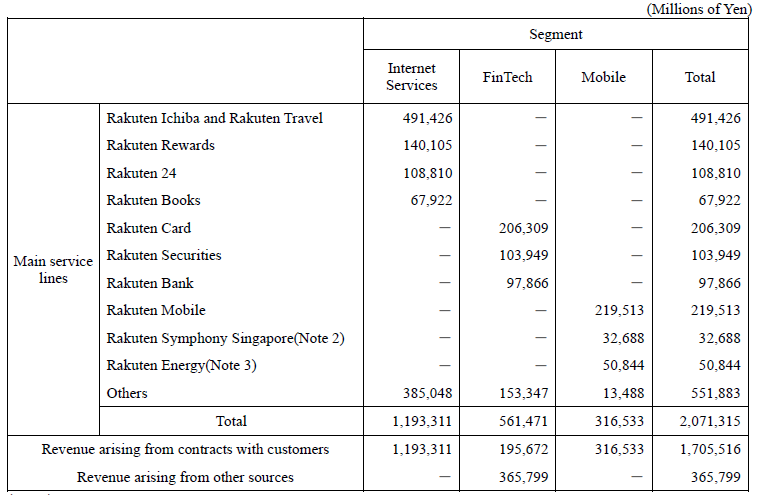
For the fiscal year ended December 31, 2023 (January 1 to December 31, 2023)
(Notes)
1. Amounts are after eliminations of intercompany transactions.
2. For the fiscal year ended December 31, 2024, revenue of Rakuten Symphony Singapore, formerly included in “Others” in the Mobile segment for the previous fiscal year, has been presented as a separate component due to its increased materiality. As a result, revenues of “Others”, which formerly amounted to ¥46,176 million respectively for the previous fiscal year, have been presented separately as ¥32,688 million of Rakuten Symphony Singapore and ¥13,488 million of “Others.”
3. Government grants based on IAS 20 are included as revenue.
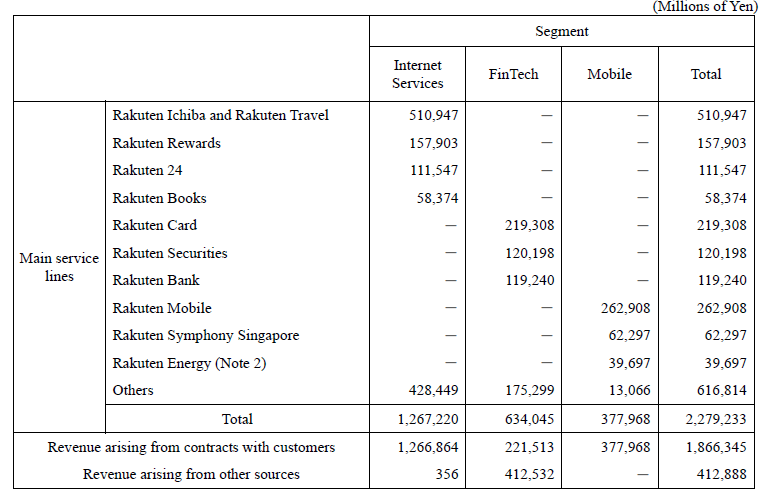
For the fiscal year ended December 31, 2024 (January 1 to December 31, 2024)
(Notes)
1. Amounts are after eliminations of intercompany transactions.
2. Government grants based on IAS 20 are included as revenue.
Interest and dividend income and other such income are recorded as revenue in accordance with IFRS 9.
For the fiscal year ended December 31, 2023, Rakuten Card, Rakuten Securities and Rakuten Bank recorded revenue of ¥155,565 million, ¥59,138 million and ¥68,612 million, respectively, in accordance with IFRS 9. For the fiscal year ended December 31, 2024, Rakuten Card, Rakuten Securities and Rakuten Bank recorded revenue of ¥166,704 million, ¥73,581 million and ¥86,554 million, respectively, in accordance with IFRS 9.
(2) Accounts arising from contracts
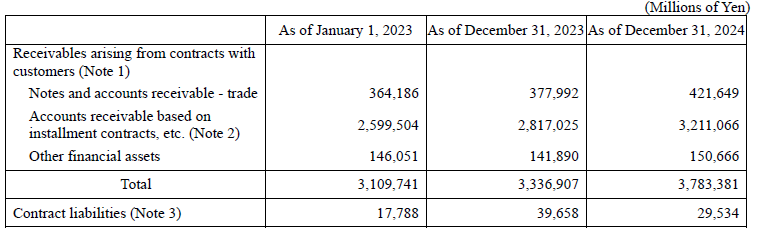
The breakdown of the balance of accounts arising from contracts of the Rakuten Group is as follows:
(Notes)
1. The amounts of impairment losses recognized for receivables arising from contracts with customers are accounts receivable of ¥2,175 million and loans for credit card business of ¥8,316 million for the year ended December 31, 2023, and accounts receivable of ¥4,484 million and loans for credit card business of ¥9,503 million for the year ended December 31, 2024.
2. This represents accounts receivable arising from the use of credit cards by customers based on installment contracts, etc., which are recorded under “Loans for credit card business” in the Consolidated Statement of Financial Position. Such accounts receivables include commissions the Rakuten Group receives.
3. Contract liabilities are recognized under “Other liabilities” in the Consolidated Statement of Financial Position.
Contract liabilities involve the receipt of consideration by the Rakuten Group prior to the fulfillment of performance obligations, and are reduced in line with the recognition of revenue as performance obligations are satisfied over the contract period, or the progress of the contract.
Contract liabilities recognized by the Rakuten Group consist mainly of deferred revenues through development and delivery of open RAN based telecommunications infrastructure platform and services etc., deferred revenues through EC platform services at Rakuten Ichiba, and deferred annual fee revenues from Rakuten Card holders.
Of the revenues recognized in the current fiscal year, ¥32,295 million was included in the balance of contract liabilities as of the beginning of the fiscal year (¥15,666 million in the previous fiscal year). In addition, the amount of revenues recognized during the previous and current fiscal year from the performance obligations satisfied (or partially satisfied) in the past periods was immaterial.
(3) Transaction Price Allocated to the Remaining Performance Obligations
The Rakuten group applies the practical expedient for disclosing the transaction price allocated to the remaining performance obligations and does not include contracts with an individual expected contract period of one year or less. Unsatisfied performance obligations consist mainly of development and delivery of open RAN based telecommunications infrastructure platform and services etc. The aggregated amount of transaction price allocated to the remaining performance obligations for the year ended December 31, 2023 and 2024 are ¥114,214 million and ¥77,891 million, respectively, and revenue is recognized in line with the progress of the development and delivery of open RAN based telecommunications infrastructure platform and services etc. Such revenue is estimated to be generated over a period of 60 months. Also, revenue related to the development and delivery of open RAN based telecommunications infrastructure platform and services etc. is recorded in Rakuten Symphony Singapore and “others” in the Mobile segment.
(4) Assets Recognized from the Costs to Obtain or Fulfill Contracts with Customers

For the years ended December 31, 2023 and 2024, amortization associated with the assets arising from contract costs of the Rakuten Group was ¥23,300 million and ¥26,345 million, respectively.
37. Insurance Revenue
Rakuten General Insurance engages in the general insurance business with automobile insurance policies as its primary product. Insurance revenues are in principle recognized by applying the general measurement model to general insurance policy groups.
Rakuten Life Insurance engages in the life insurance business with health insurance policies as its primary product. Insurance revenues are in principle recognized by applying the general measurement model to life insurance policy groups.

 Accounts examples