IFRS 15, software, policies, judgements

The Sage Group plc – Annual report – 30 September 2024

Industry: software

3.1 Revenue

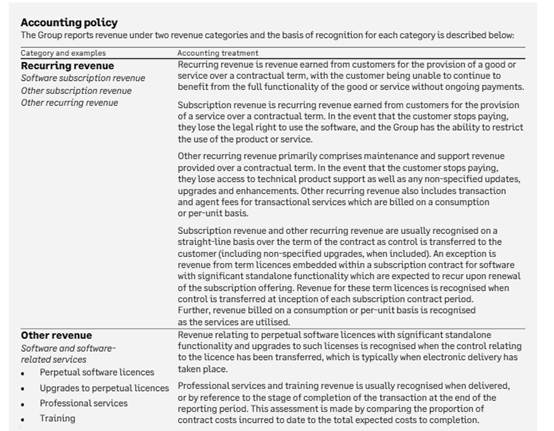
Accounting policy The Group reports revenue under two revenue categories and the basis of recognition for each category is described below:

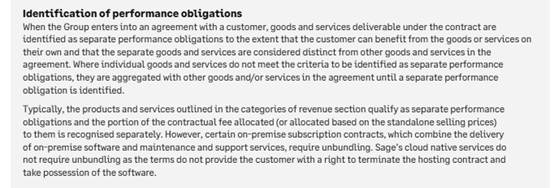
Identification of performance obligations

When the Group enters into an agreement with a customer, goods and services deliverable under the contract are identified as separate performance obligations to the extent that the customer can benefit from the goods or services on their own and that the separate goods and services are considered distinct from other goods and services in the agreement. Where individual goods and services do not meet the criteria to be identified as separate performance obligations, they are aggregated with other goods and/or services in the agreement until a separate performance obligation is identified.

Typically, the products and services outlined in the categories of revenue section qualify as separate performance obligations and the portion of the contractual fee allocated (or allocated based on the standalone selling prices) to them is recognised separately. However, certain on-premise subscription contracts, which combine the delivery of on-premise software and maintenance and support services, require unbundling. Sage’s cloud native services do not require unbundling as the terms do not provide the customer with a right to terminate the hosting contract and take possession of the software.

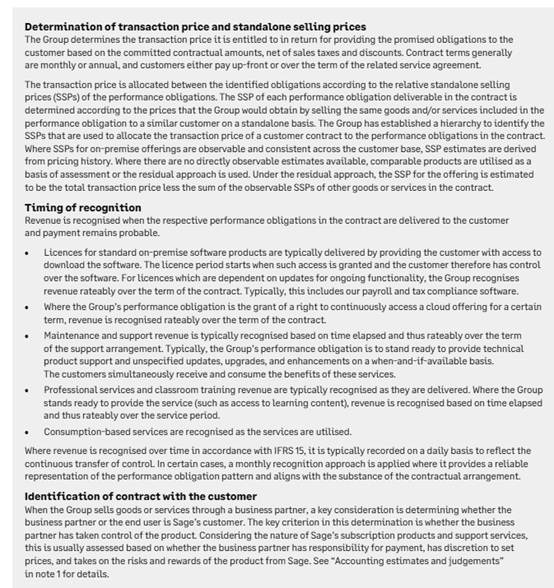
Determination of transaction price and standalone selling prices

The Group determines the transaction price it is entitled to in return for providing the promised obligations to the customer based on the committed contractual amounts, net of sales taxes and discounts. Contract terms generally are monthly or annual, and customers either pay up-front or over the term of the related service agreement.

The transaction price is allocated between the identified obligations according to the relative standalone selling prices (SSPs) of the performance obligations. The SSP of each performance obligation deliverable in the contract is determined according to the prices that the Group would obtain by selling the same goods and/or services included in the performance obligation to a similar customer on a standalone basis. The Group has established a hierarchy to identify the SSPs that are used to allocate the transaction price of a customer contract to the performance obligations in the contract. Where SSPs for on-premise offerings are observable and consistent across the customer base, SSP estimates are derived from pricing history. Where there are no directly observable estimates available, comparable products are utilised as a basis of assessment or the residual approach is used. Under the residual approach, the SSP for the offering is estimated to be the total transaction price less the sum of the observable SSPs of other goods or services in the contract.

Timing of recognition

Revenue is recognised when the respective performance obligations in the contract are delivered to the customer and payment remains probable.

  • Licences for standard on-premise software products are typically delivered by providing the customer with access to download the software. The licence period starts when such access is granted and the customer therefore has control over the software. For licences which are dependent on updates for ongoing functionality, the Group recognises revenue rateably over the term of the contract. Typically, this includes our payroll and tax compliance software.
  • Where the Group’s performance obligation is the grant of a right to continuously access a cloud offering for a certain term, revenue is recognised rateably over the term of the contract.
  • Maintenance and support revenue is typically recognised based on time elapsed and thus rateably over the term of the support arrangement. Typically, the Group’s performance obligation is to stand ready to provide technical product support and unspecified updates, upgrades, and enhancements on a when-and-if-available basis. The customers simultaneously receive and consume the benefits of these services.
  • Professional services and classroom training revenue are typically recognised as they are delivered. Where the Group stands ready to provide the service (such as access to learning content), revenue is recognised based on time elapsed and thus rateably over the service period.
  • Consumption-based services are recognised as the services are utilised.

Identification of contract with the customer

When the Group sells goods or services through a business partner, a key consideration is determining whether the business partner or the end user is Sage’s customer. The key criterion in this determination is whether the business partner has taken control of the product. Considering the nature of Sage’s subscription products and support services, this is usually assessed based on whether the business partner has responsibility for payment, has discretion to set prices, and takes on the risks and rewards of the product from Sage. See “Accounting estimates and judgements” in note 1 for details.

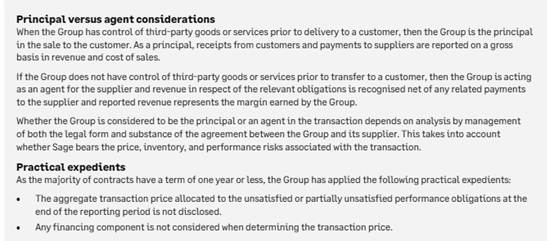
Principal versus agent considerations

When the Group has control of third-party goods or services prior to delivery to a customer, then the Group is the principal in the sale to the customer. As a principal, receipts from customers and payments to suppliers are reported on a gross basis in revenue and cost of sales.

If the Group does not have control of third-party goods or services prior to transfer to a customer, then the Group is acting as an agent for the supplier and revenue in respect of the relevant obligations is recognised net of any related payments to the supplier and reported revenue represents the margin earned by the Group.

Whether the Group is considered to be the principal or an agent in the transaction depends on analysis by management of both the legal form and substance of the agreement between the Group and its supplier. This takes into account whether Sage bears the price, inventory, and performance risks associated with the transaction.

Practical expedients

As the majority of contracts have a term of one year or less, the Group has applied the following practical expedients:

  • The aggregate transaction price allocated to the unsatisfied or partially unsatisfied performance obligations at the end of the reporting period is not disclosed.
  • Any financing component is not considered when determining the transaction price.

1 Basis of preparation and accounting estimates and judgements (extract)

Accounting estimates and judgements (extract)

Revenue recognition (judgement)

Over a third of the Company’s revenue is generated from sales to business partners rather than end users. The key judgement is determining whether the business partner is a customer of the Group. The key criterion in this determination is whether the business partner has taken control of the product. Considering the nature of Sage’s subscription products and support services, this is usually assessed based on whether the business partner has responsibility for payment, has discretion to set prices, and takes on the risks and rewards of the product from Sage.

Where the business partner is a customer of Sage, discounts are recognised as a deduction from revenue.

Where the business partner is not a customer of Sage and their part in the sale has simply been in the form of a referral, they are remunerated in the form of a commission payment. These payments are treated as contract acquisition costs (see note 8.1).