BT Group plc – Annual report – 31 March 2025
Industry: telecoms
5. Revenue
Material accounting policies that apply to revenue
Revenue from contracts with customers in scope of IFRS 15
Most revenue recognised by the group is in scope of IFRS 15, excluding Openreach where most revenue is in scope of IFRS 16. The revenue recognition policy for both is set out below.
On inception of the contract we identify a “performance obligation” for each of the distinct goods or services we have promised to provide to the customer. The consideration specified in the contract with the customer is allocated to each performance obligation identified based on their relative standalone selling prices, and is recognised as revenue as they are satisfied.
The table below summarises the performance obligations we have identified for our major service lines and provides information on the timing of when they are satisfied and the related revenue recognition policy. Also detailed in this note is revenue expected to be recognised in future periods for contracts in place at 31 March 2025 that contain unsatisfied performance obligations.

We recognise revenue based on the relative standalone selling price of each performance obligation. Determining the standalone selling price often requires judgement and may be derived from regulated prices, list prices, a cost-plus derived price or the price of similar products when sold on a standalone basis by BT or a competitor. In some cases it may be appropriate to use the contract price when this represents a bespoke price that would be the same for a similar customer in a similar circumstance.
The fixed access and mobile subscription arrangements sold by our Consumer business are typically payable in advance, with any variable or one-off charges billed in arrears. Contracts are largely inflation-linked with price increases recognised when effective. Payment is received immediately for direct sales of equipment to customers. Where equipment is provided to customers under mobile and fixed access subscription arrangements, payment for the equipment is received over the course of the contract term. Payments received in advance are recognised as contract liabilities; amounts billed in arrears are recognised as contract assets.
We adopt variable consideration to allocate the transaction price to take account of the likelihood of the customer upgrading to a new handset during the contract term. Consideration is constrained to a period shorter than the contract term and is allocated to the handset and airtime based on relative standalone selling price. Certain Business long-term contracts offer rebates to our customers. Where this is the case we make an estimate of variable consideration at the outset of the contract based on assumed volumes. These rebates are normally settled monthly against service revenues.
We are applying the practical expedient to recognise revenue “as-invoiced” for certain fixed access and mobile subscription services revenues. Where we have a right to invoice at an amount that directly corresponds with performance to date, we recognise revenue at that amount. We have also adopted the practical expedient not to calculate the aggregate amount of the transaction price allocated to the performance obligations that are unsatisfied for these contracts.
We do not have any material obligations in respect of returns, refunds or warranties.
Where we act as an agent in a transaction, such as certain insurance services offered, we recognise commission net of directly attributable costs.
We exercise judgement in assessing whether the initial set-up, transition and transformation phases of long-term contracts are distinct from the other services to be delivered under the contract and therefore represent separate performance obligations. This determines whether revenue is recognised in the early stages of the contract, or deferred until delivery of the other services promised in the contract begins.
We recognise immediately the entire estimated loss for a contract when we have evidence that the contract is unprofitable. If these estimates indicate that a contract will be less profitable than previously forecast, contract assets may have to be written down to the extent they are no longer considered to be fully recoverable. We perform ongoing profitability reviews of our contracts in order to determine whether the latest estimates are appropriate. Key factors reviewed include:
- Transaction volumes or other inputs affecting future revenues which can vary depending on customer requirements, plans, market conditions and other factors such as general economic conditions.
- Our ability to achieve key contract milestones connected with the transition, development, transformation and deployment phases for customer contracts.
- The status of commercial relations with customers and the implications for future revenue and cost projections.
- Our estimates of future staff and third party costs and the degree to which cost savings and efficiencies are deliverable.
Revenue from lease arrangements in scope of IFRS 16
Some consumer broadband and TV products and arrangements to provide external communications providers with exclusive use of Openreach’s fixed-network telecommunications infrastructure meet the definition of operating leases under IFRS 16.
At inception of a contract, we determine whether the contract is, or contains, a lease following the accounting policy set out in note 15. Arrangements meeting the definition of a lease in which we act as lessor are classified as operating or finance leases at lease inception based on an overall assessment of whether the lease transfers substantially all the risks and rewards incidental to ownership of the underlying asset. If this is the case then the lease is a finance lease; if not, it is an operating lease. For sub-leases, we make this assessment by reference to the characteristics of the right-of-use asset associated with the head lease rather than the underlying leased asset.
Income from arrangements classified as operating leases is presented as revenue where it relates to our core operating activities, for example leases of fixed-line telecommunications infrastructure to external communications providers and leases of devices to consumer customers as part of fixed access subscription products. Operating lease income from other arrangements is presented within other operating income (note 6).
We recognise operating lease payments as income on a straight-line basis over the lease term. Any upfront payments received, such as connection fees, are deferred over the lease term. Determining the lease term is subject to the significant judgements set out in note 15.
Where the contract contains both lease and non-lease components, the transaction price is allocated between the components on the basis of relative standalone selling price.
Where an arrangement is assessed as a finance lease we derecognise the underlying asset and recognise a receivable equivalent to the net investment in the lease. Finance lease receivables are presented in note 16. The receivable is measured based on future payments to be received discounted using the interest rate implicit in the lease, adjusted for any direct costs. Any difference between the derecognised asset and the finance lease receivable is recognised in the income statement. Where the nature of services delivered relates to our core operating activities it is presented as revenue. Where it relates to non-core activities it is presented within other operating income (note 6).
Disaggregation of external revenue
The following table disaggregates external revenue by our major service lines and by reportable segment.
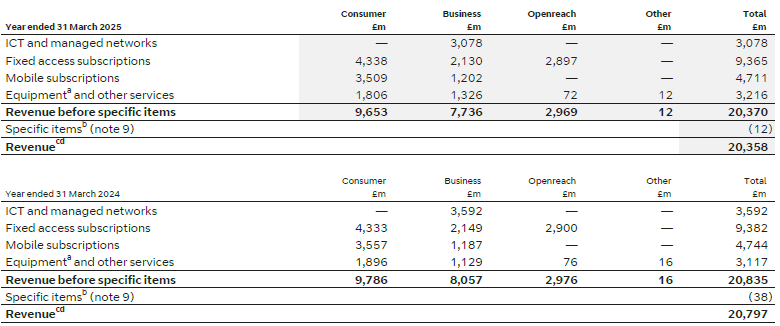
a Includes UK equipment revenue of £2,310m (FY24: £2,391m).
b Relates to regulatory matters classified as specific. See note 9.
c The Group’s revenue at 31 March 2025 relating to contracts with customers, as defined by IFRS 15, amounts to £17,358m (FY24: £17,766m).
d We have further disaggregated the revenue presented here to derive the UK adjusted service revenue of £15,582m (FY24: £15,727m). Please refer to our adjusted UK service revenue reconciliation in the Additional Information section of this report for details. Adjusted UK service revenue includes some portion of equipment revenue where that equipment is sold as part of a managed services contract, or where that equipment cannot be practicably separated from the underlying service.
Revenue expected to be recognised in future periods for performance obligations that are not complete (or are partially complete) as at 31 March 2025 is £13,249m (FY24: £12,133m). Of this, £6,477m (FY24: £6,052m) relates to ICT and managed services contracts and equipment and other services which will substantially be recognised as revenue within three years. Fixed access and mobile subscription services typically have shorter contract periods and so £6,772m (FY24: £6,081m) will substantially be recognised as revenue within two years.
Key accounting estimates made in accounting for revenue
Estimate of customer refunds
There remains an accounting estimate in place to reflect a risk of billing inaccuracy where there is the presence of bespoke pricing. This is associated with a small number of products across a limited number of billing systems. We have previously recognised a combined £51m and based on the results of testing there has been no change to the expected value of the liability. As a result, there is no additional recognition or revenue deduction made in the current financial year. The value of this estimate is based on a range of potential adjustments, none of which materially deviate from the amount currently recorded.
This is presented within note 17 and represents our best estimate required to cover ongoing billing adjustments to products relating to both current and prior periods. If the final quantum of adjustments is less than expected, the adjustment will be released back to the income statement.
Lease income
Presented within revenue is £3,000m (FY24: £3,031m) income from arrangements classified as operating leases under IFRS 16 and which represent core business activities for the group. Income relates predominantly to Openreach’s leases of fixed-line telecommunications infrastructure to external communications providers, classified as fixed access subscription revenue in the table above, and leases of devices to Consumer customers as part of fixed access subscription offerings, classified as equipment and other services.
During the year we also recognised:
- £19m (FY24: £26m) operating lease income from non-core business activities which is presented in other operating income (note 6). Note 15 presents an analysis of payments to be received across the remaining term of operating lease arrangements.
- £12m (FY24: £40m) revenue in relation to upfront gains from arrangements meeting the definition of a finance lease. These arrangements meet the criteria for revenue recognition as they concern leases and sub-leases of telecommunications infrastructure that represent core business activities of the group.
£33m (FY24: £38m) of this income relates to the sub-leasing of right-of-use assets. These are primarily operating sub-leases of unutilised properties, and finance sub-leases of telecommunications infrastructure.
Contract assets and liabilities
Material accounting policies that apply to contract assets and liabilities
We recognise contract assets for goods and services for which control has transferred to the customer before we have the right to bill. These assets mainly relate to mobile handsets provided upfront but paid for over the course of a contract. Contract assets are reclassified as receivables when the right to payment becomes unconditional and we have billed the customer.
Contract liabilities are recognised when we have received advance payment for goods and services that we have not transferred to the customer. These primarily relate to fees received for connection and installation services that are not distinct performance obligations.
Where the initial set-up, transition or transformation phase of a long-term contract is considered to be a distinct performance obligation we recognise a contract asset for any work performed but not billed. Conversely a contract liability is recognised where these activities are not distinct performance obligations and we receive upfront consideration. In this case eligible costs associated with delivering these services are capitalised as fulfilment costs, see note 16.
We provide for expected lifetime losses on contract assets following the policy set out in note 16. Contract assets and liabilities are as follows:

£704m (FY24: £876m) of the contract liability at 31 March 2024 was recognised as revenue during the year. Impairment losses of £47m (FY24: £35m) were recognised on contract assets during the year.
The expected credit loss provisions recognised against contract assets vary across the group due to the nature of our customers; the expected loss rate at 31 March 2025 was 3% (FY24: 3%).
16. Trade and other receivables
Material accounting policies that apply to trade and other receivables
Trade receivables are recognised where the right to receive payment from customers is conditional only on the passage of time. We initially recognise trade and other receivables at fair value, which is usually the original invoiced amount. They are subsequently carried at amortised cost using the effective interest method. The carrying amount of these balances approximates to fair value due to the short maturity of amounts receivable.
We provide services to consumer and business customers, mainly on credit terms. We know that certain debts due to us will not be paid through the default of a small number of our customers. Because of this, we recognise an allowance for doubtful debts on initial recognition of receivables, which is deducted from the gross carrying amount of the receivable. The allowance is calculated by reference to credit losses expected to be incurred over the lifetime of the receivable. In estimating a loss allowance we consider historical experience and informed credit assessment alongside other factors such as the current state of the economy and particular industry issues. We consider reasonable and supportable information that is relevant and available without undue cost or effort.
Once recognised, trade receivables are continuously monitored and updated. Allowances are based on our historical loss experiences for the relevant aged category as well as forward-looking information and general economic conditions. Allowances are calculated by individual CFUs in order to reflect the specific nature of the customers relevant to that CFU.
The group utilises factoring arrangements for selected trade receivables. Trade receivables that are subject to debt factoring arrangements are derecognised if they meet the conditions for derecognition detailed in IFRS 9 ‘Financial instruments’ and the related cash flows received are presented as cash flows from operating activities. Where a portfolio of trade receivables are either sold or held to collect the contractual cash flows, they are recorded at fair value through other comprehensive income.
Contingent assets such as any insurance recoveries which we expect to recoup, have not been recognised in the financial statements as these are only recognised within trade and other receivables when their receipt is virtually certain.

a Other assets comprise Flex Pay receivables and £35m (FY24: £57m) of deferred cash consideration mainly relating to the FY23 disposal of BT Sport.
Amounts due from joint ventures relates to a sterling Revolving Credit Facility (RCF) provided to the Sports JV, see note 30. The expected loss provision is immaterial.
The company has a facility with a third party for the sale of mobile handset receivables. Under this facility, the Group transfers substantially all of the risks and rewards to the third party, and therefore has derecognised the transferred receivables. During FY25, we received net cash flows of £420m (FY24: £76m) through this facility. The cashflows are included within the ‘Decrease (increase) in trade and other receivables’ line in the ‘Statement of Cash Flows’. The net impact of working capital programmes on normalised free cash flow is set out in the Groups Alternative Performance Measures.
Trade receivables are stated after deducting allowances for doubtful debts, as follows:

The expected credit loss allowance for trade receivables was determined as follows:

Trade receivables not past due and accrued income are analysed below by CFU.

Given the broad and varied nature of our customer base, the analysis of trade receivables not past due and accrued income by CFU is considered the most appropriate disclosure of credit concentrations.
Deferred contract costs
Material accounting policies that apply to deferred contract costs
We capitalise certain costs associated with the acquisition and fulfilment of contracts with customers and amortise them over the period that we transfer the associated services.
Connection costs are deferred as contract fulfilment costs because they allow satisfaction of the associated connection performance obligation and are considered recoverable. Sales commissions and other third party contract acquisition costs are capitalised as costs to acquire a contract unless the associated contract term is less than 12 months, in which case they are expensed as incurred. Capitalised costs are amortised over the minimum contract term. A portfolio approach is used to determine contract term.
Where the initial set-up, transition and transformation phases of long-term contractual arrangements represent distinct performance obligations, costs in delivering these services are expensed as incurred. Where these services are not distinct performance obligations, we capitalise eligible costs as a cost of fulfilling the related service. Capitalised costs are amortised on a straight-line basis over the remaining contract term, unless the pattern of service delivery indicates a more appropriate profile. To be eligible for capitalisation, costs must be directly attributable to specific contracts, relate to future activity, and generate future economic benefits. Capitalised costs are regularly assessed for recoverability.
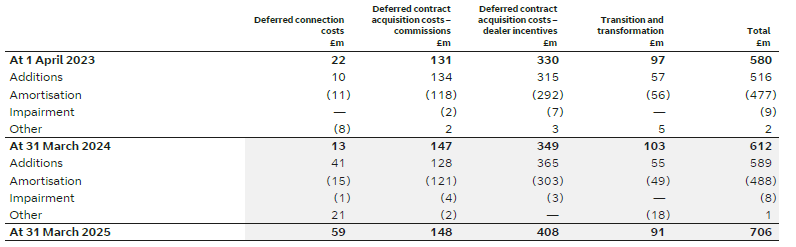
The following table shows the movement on deferred costs:

 Accounts examples