AstraZeneca PLC – Annual report – 31 December 2025
Industry: pharmaceuticals
Audit Committee Report (extract)
Significant financial reporting issues considered by the Committee in 2025 (extract)
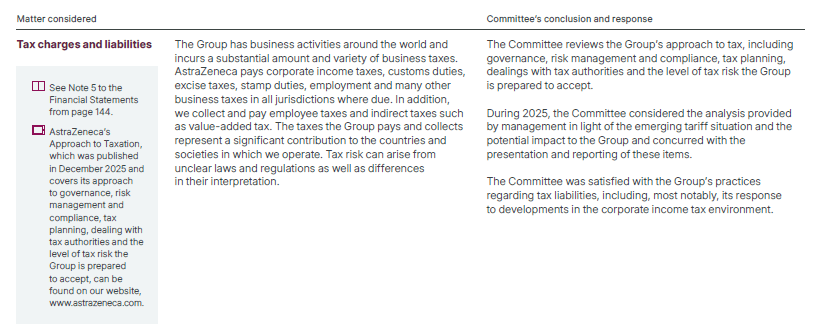
Group Accounting Policies (extract 1)
Estimates and judgements
The preparation of the Financial Statements in conformity with generally accepted accounting principles requires management to make estimates and judgements that affect the reported amounts of assets and liabilities at the date of the Financial Statements and the reported amounts of revenues and expenses during the reporting period. Actual results could differ from those estimates.
The accounting policy descriptions set out the areas where judgements and estimates need exercising, the most significant of which include the following Key Judgements KJ and Significant Estimates SE :
- revenue recognition – see Revenue accounting policy on page 130 KJ and Note 2 on page 141 SE
- expensing of internal development expenses – see Research and development accounting policy on page 131 KJ
- impairment reviews of Intangible assets – see Note 11 on page 153 SE
- useful economic life of Intangible assets – see Research and development accounting policy on page 131 KJ
- business combinations and Goodwill – see Business combinations and goodwill accounting policy on page 134 KJ
- litigation liabilities – see Legal proceedings within Note 30 on page 181 KJ
- operating segments – see Note 7 on page 147 KJ
- employee benefits – see Note 22 on page 168 SE
- taxation – see Note 30 on page 190 KJ .
The Group has assessed the impact of sustainability topics on its financial reporting. This includes an impact assessment on the valuation and useful lives of Intangible assets and the identification and measurement of provisions and contingent liabilities in response to climate and pollution risks.
Sustainability-related opportunities on innovation are integral to the Financial Statements with a key indicator of the Group’s investment being Research and development (R&D) expense. Business conduct and patient safety are both considered as part of our recognition and measurement of provisions and contingent liabilities, noted within sections of Government investigations and proceedings and Product liability litigation as relevant, of Note 30. No material accounting impacts or changes to judgements or other required disclosures were noted.
KJ Key Judgements are those judgements made in applying the Group’s accounting policies that have a material effect on the amounts of assets and liabilities recognised in the Financial Statements.
SE A Significant Estimate has a significant risk of material adjustment to the carrying amounts of assets and liabilities within the next financial year.
Group Accounting Policies (extract 2)
Taxation
The current tax payable is based on taxable profit for the year. Taxable profit differs from reported profit because taxable profit excludes items that are either never taxable or tax deductible or items that are taxable or tax deductible in a different period. The Group’s current tax assets and liabilities are calculated using tax rates that have been enacted or substantively enacted by the reporting date. Current tax includes the Group’s charge for any Pillar Two income taxes.
Deferred tax is provided using the balance sheet liability method, providing for temporary differences between the carrying amounts of assets and liabilities for financial reporting purposes and the amounts used for taxation purposes. Deferred tax liabilities are recognised unless they arise from the initial recognition (other than in a business combination) of assets and liabilities in a transaction that affects neither the taxable profit nor the accounting profit. Deferred tax liabilities are not recognised to the extent they arise from the initial recognition of non-tax deductible goodwill. Deferred tax assets are recognised to the extent that there are future taxable temporary differences or it is probable that future taxable profit will be available against which the asset can be utilised. This requires judgements to be made in respect of the availability of future taxable income.
The Group applies the exception to recognising and disclosing information about deferred tax assets and liabilities related to Pillar Two income taxes, as provided in the amendments to IAS 12 ‘Income Taxes’ issued in May 2023.
No deferred tax asset or liability is recognised in respect of temporary differences associated with investments in subsidiaries and branches where the Group is able to control the timing of reversal of the temporary differences and it is probable that the temporary differences will not reverse in the foreseeable future.
The Group’s deferred tax assets and liabilities are calculated using tax rates that are expected to apply in the period when the liability is settled or the asset realised based on tax rates that have been enacted or substantively enacted by the reporting date. Deferred tax liabilities relating to assets recognised because of a business combination which may qualify for intellectual property incentives are measured at the relevant statutory tax rate. Deferred tax assets and liabilities are offset in the Consolidated Statement of Financial Position if, and only if, the taxable entity has a legally enforceable right to set off current tax assets and liabilities, and the Deferred tax assets and liabilities relate to taxes levied by the same taxation authority on the same taxable entity.
Liabilities for uncertain tax positions require management to make judgements of potential exposures in relation to tax audit issues based upon interpretation of applicable laws and regulations and the expectation of how the tax authority will resolve the matter. Tax benefits are recognised when it is probable the tax positions will be accepted by the tax authorities. When a position is not considered probable of being accepted, management reviews each material tax benefit and reflects the effect of the uncertainty in determining the related taxable result. This is measured using either the most likely amount or the expected value amount depending on which method the entity expects to better predict the resolution of the uncertainty.
Further details of the estimates and assumptions made in determining our recorded liability for transfer pricing contingencies and other tax contingencies are included in Note 30 to the Financial Statements from page 189.
30 Commitments, contingent liabilities and contingent assets (extract)
Tax
AstraZeneca considers whether it is probable that a taxation authority will accept an uncertain tax treatment. Where acceptance of an uncertain tax treatment is not considered probable, a tax liability is recognised based on either the most likely amount method or the expected value method depending on which method management expects to better predict the resolution of the uncertainty. Due to inherent complexities in the resolution of the uncertain tax treatments and the resulting liabilities due, management exercise judgement in the measurement of the potential liability, based on information available at the present time.
Tax liabilities for uncertain tax treatments can be built up over a long period of time but the resolution occurs at a point in time. Therefore, to the extent the information changes in future periods, there may be adjustments to the liabilities, which may have either a negative or positive effect on our results. Such changes could arise from commencement, progress or conclusion of tax authority challenge, negotiations under competent authority arrangements in relevant double tax treaties and expiry of relevant statutes of limitation. Details of the movements of material uncertain tax treatments are included below.
KJ AstraZeneca faces a number of audits and reviews in jurisdictions around the world and, in some cases, is in dispute with the tax authorities. The issues under discussion are often complex and can require many years to resolve. Tax liabilities recognised for uncertain tax treatments require management to make key judgements with respect to the outcome of current and potential future tax audits, and actual results could vary from these estimates. Management does not believe a significant risk exists of material change to uncertain tax positions in the next 12 months.
The total net tax liability recognised in the Group Financial Statements in respect of uncertain tax positions is $1,104m (2024: $1,321m). The net tax liability consists of $1,126m (2024: $1,157m) included within income tax payable, $1,628m (2024: $1,304m) included within deferred tax asset, partially offset by $205m (2024: $122m) included within deferred tax liabilities, and $1,445m (2024: $1,018m) included within income tax receivable.
Transfer pricing
The net tax liability included in the Group Financial Statements in relation to management’s current assessment of tax risks in relation to worldwide transfer pricing exposures is $120m (2024: $384m). The decrease in the net tax liability for uncertain tax positions relating to transfer pricing of $264m compared with 2024 is mainly as a result of a decrease of tax liabilities arising from updates to estimates of prior period tax liabilities following progression of tax authority reviews.
The liability includes uncertain tax treatments which are estimated using the expected value method and depend on AstraZeneca’s assessment of the likelihood of the approach taken by the tax authorities. These matters can be complex and judgemental and could change in the future, as discussed above.
For transfer pricing matters, including items under tax audit, AstraZeneca estimates the potential for additional tax liabilities above the amount provided where the possibility of the additional liabilities falling due is more than remote, to be up to $79m (2024: $422m) including associated interest.
Management continues to believe that AstraZeneca’s positions on all its transfer pricing positions, audits and disputes are robust, and that AstraZeneca has recognised appropriate tax balances, including consideration of whether corresponding relief will be available under Mutual Agreement procedures or unilaterally.
Other uncertain tax treatments
Included in the net tax liability is $984m (2024: $937m) relating to a number of other uncertain tax treatments. The increase of $47m in the net tax liability relating to the other uncertain tax treatments mainly relates to an update to tax liabilities following progress of reviews by tax authorities which are offset by movements relating to uncertainty over the timing of tax deductions. This uncertainty includes movements between income taxes receivable of $1,391m (2024: $742m), and deferred tax liabilities of $234m (2024: $133m) offset by related deferred tax assets of $1,611m (2024: $929m) and income taxes payable of $496m (2024: $269m). The liability includes tax liabilities in respect of uncertain tax treatments which are estimated using the most likely amount method and the expected value method and depend on AstraZeneca’s assessment of the likelihood of the approach taken by the tax authorities.
AstraZeneca estimates the potential for additional liabilities due to other uncertain tax treatments above the amount provided where the possibility of the additional liabilities falling due is more than remote, to be up to $127m (2024: $214m) including associated interest. AstraZeneca does not believe there are any significant other uncertain tax treatments where the possibility of the additional liabilities falling due is more than remote (2024: $nil). Management believes that it is unlikely that these additional liabilities will arise.
Timing of cash flows and interest
The Group is currently under audit in several countries and the timing of any resolution of these audits is uncertain.
It is possible that tax payments may be required in relation to a number of disputes which may be resolved over the next one to two years. AstraZeneca considers the tax liabilities set out above to appropriately reflect the expected value of any final settlement. Some of the items discussed above are not currently within the scope of tax authority audits and may take longer to resolve.
Included within other payables is a net amount of interest arising on tax contingencies of $126m (2024: $164m).
 Accounts examples