AstraZeneca PLC – Annual report – 31 December 2023
Industry: pharmaceuticals
Directors’ Remuneration Policy
Changes to Remuneration Policy and its implementation
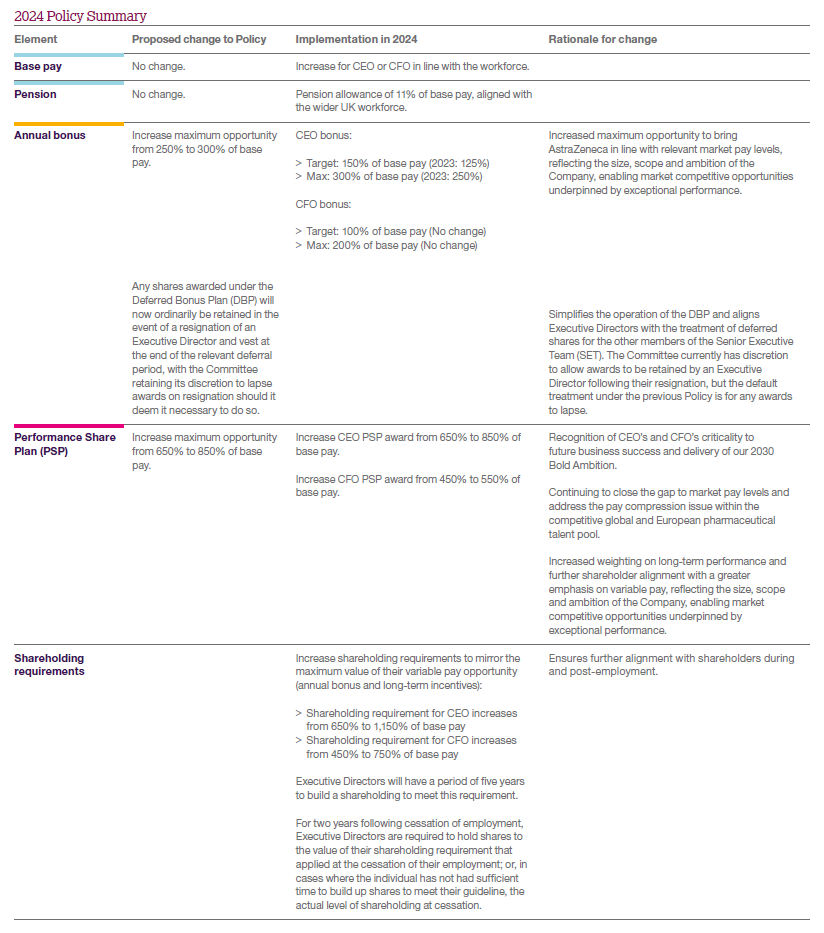
The table below summarises the main proposed changes to the Directors’ Remuneration Policy (the Policy), the intended changes to implementation of the Policy in 2024 and the rationale for each change.
The full Policy that shareholders will be asked to approve is set out from page 128.
Remuneration Policy
This section sets out the Policy proposed for approval by shareholders at the Company’s AGM on 11 April 2024. Subject to shareholder approval, the Policy is intended to remain in effect for three years from the 2024 AGM. The previous page summarises how the new Policy differs from the Policy which was approved by shareholders at the 2021 AGM.
Setting the Policy
The Remuneration Committee (the Committee) is responsible for setting overall remuneration policy and makes decisions about specific remuneration arrangements in the broader context of employee remuneration throughout the Group. The Committee reviews remuneration data for the wider workforce at several points during the year, including ratios of average employee pay to senior executive pay; bonus and base pay data; as well as gender and geographical data in relation to base pay and variable compensation. This includes a workforce remuneration review to understand the ways in which reward is differentiated by contribution across the population.
Remuneration for all roles within the organisation is benchmarked against that for comparable roles in similar organisations and in the employee’s local market. Executive Directors’ remuneration is benchmarked against global and European pharmaceutical peer groups. In reviewing the base pay of Executive Directors, the Committee considers the overall level of any base pay increases being awarded to employees in the Executive Director’s local market in the relevant year. In setting, reviewing and implementing the Policy, the Committee seeks independent advice and ensures that no Director makes decisions relating to their own remuneration. The Committee connects with the Audit Committee to ensure that the Group’s remuneration policies and practices achieve the right balance between appropriate incentives to reward good performance, management of risk, and the pursuit of the Company’s strategic objectives.
The Board as a whole takes responsibility for gathering the views of AstraZeneca’s workforce, and does so through multiple channels of engagement. While the Committee does not consult employees specifically when setting the Policy, the Company engages with employees, either on a Group-wide basis or in the context of smaller focus groups, to solicit feedback generally on a wide range of matters, including pay. Details of our approach to executive remuneration and its implementation are available to employees on our intranet site, Nucleus. Many employees are also shareholders in the Company and therefore have the opportunity to vote on the Policy at the 2024 AGM.
In all aspects of its work, the Committee considers both the external environment in which the Company operates and the guidance issued by organisations representing institutional shareholders. It consults the Company’s major investors on general and specific remuneration matters and provides opportunities for representatives of those investors to meet the Chair of the Committee and other Committee and Board members. It is the Company’s policy to seek input from major shareholders on an ad hoc basis when significant changes to remuneration arrangements are proposed. A thorough consultation process was undertaken as this Policy was developed, with investors’ feedback on the Committee’s proposals influencing the final Policy. The Company’s shareholders are encouraged to attend the AGM and any views expressed will be considered by Committee members.
Legacy arrangements
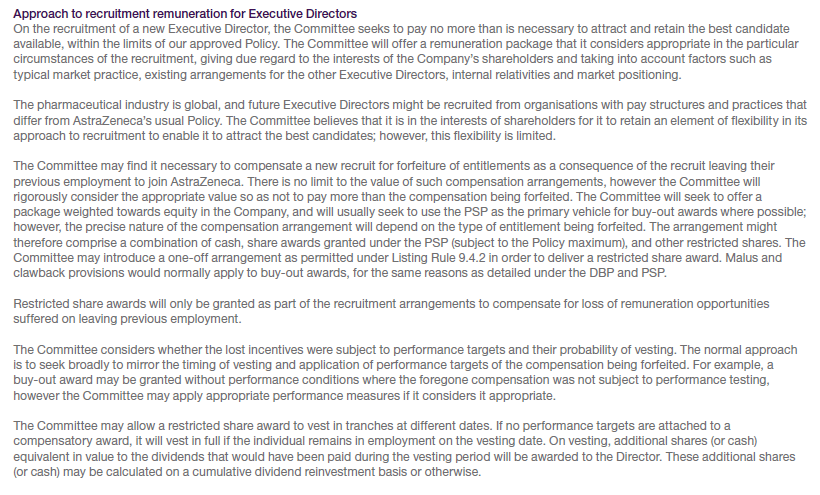
The Committee may approve remuneration payments and payments for loss of office on terms that differ to the terms in the Policy where the terms of the payment were agreed before the Policy came into effect or were agreed at a time when the relevant individual was not a Director of the Company (provided that, in the opinion of the Committee, the agreement was not entered into in consideration for the individual becoming a Director of the Company). This includes the exercise of any discretion available to the Committee in connection with such payments. For these purposes, payments include the Committee satisfying awards of variable remuneration, including share awards, in line with the terms agreed at the time the award was granted.
Minor amendments
The Committee may make minor amendments to the arrangements for Directors described in the Policy without shareholder approval for regulatory, exchange control, tax or administrative purposes or to take account of a change in legislation.


Differences in remuneration policy for other employees
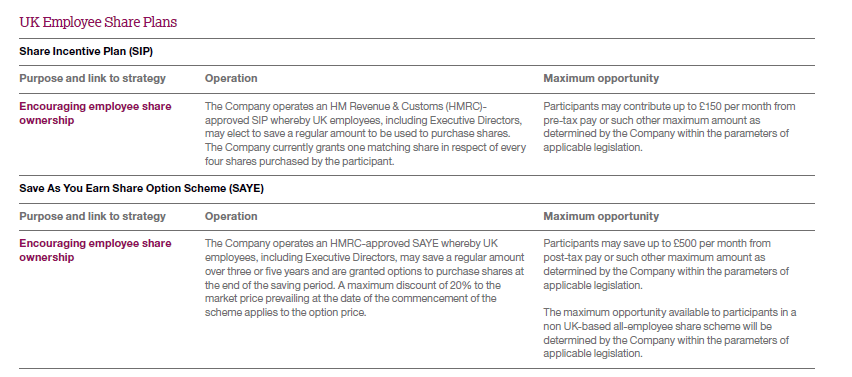
The Company’s approach to determining and reviewing the base pay of the Executive Directors and the employee population as a whole is the same. On an annual basis, the base pay for individual roles are reviewed in the context of the external market. AstraZeneca participates in annual global compensation surveys, which provide benchmarking data for all roles within the organisation, ensuring a robust base pay review process for all roles. The Company seeks to provide an appropriate range of competitive benefits, including healthcare and pension, to all employees (including Executive Directors) in the context of their local market.
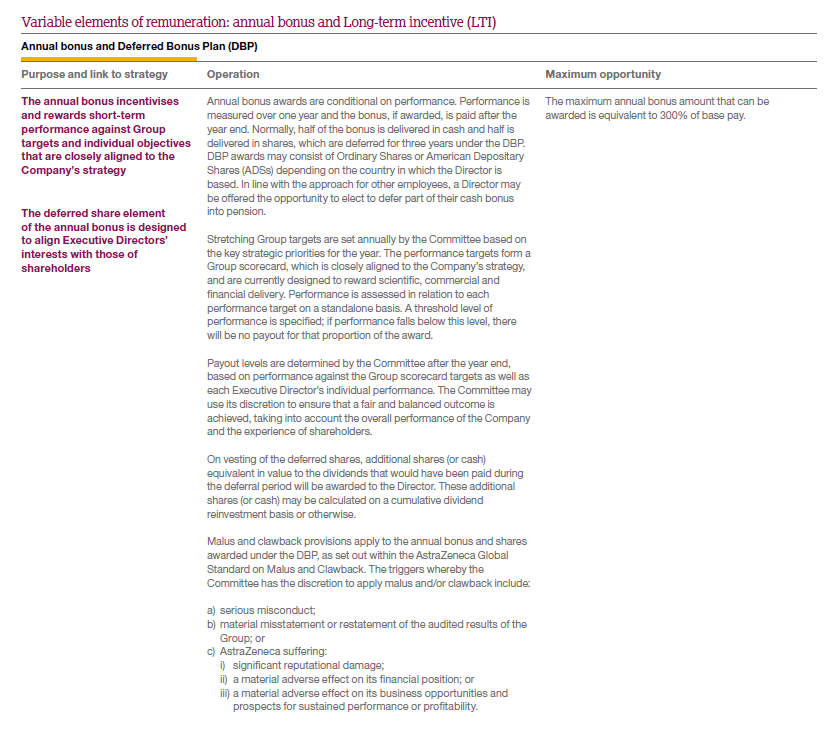
Employees globally may be eligible for LTI awards in the form of the PSP and/or restricted stock units depending on their level and market. The occupants of senior roles in the Company are currently eligible for PSP awards – these are the leaders who have the ability to directly influence the execution of the Company’s strategic goals. A proportion of each Senior Executive Team (SET) member’s annual bonus is deferred into shares under the DBP. An LTI award may be used for the same purpose as described above on the recruitment of employees, or for employees other than Directors, for retention.
Remuneration scenarios for Executive Directors
The charts below illustrate how much the current Executive Directors could receive under different performance scenarios in 2024. Dividend equivalents payable in respect of PSP awards are not included in the scenarios. To compile the charts, the following assumptions have been made:


 Accounts examples