Burberry Group plc – Annual report – 29 March 2025
Industry: retail
SUSTAINABILITY INFORMATION (page 41 extract)
2. Basis for preparation (extract)
Frameworks and legislation
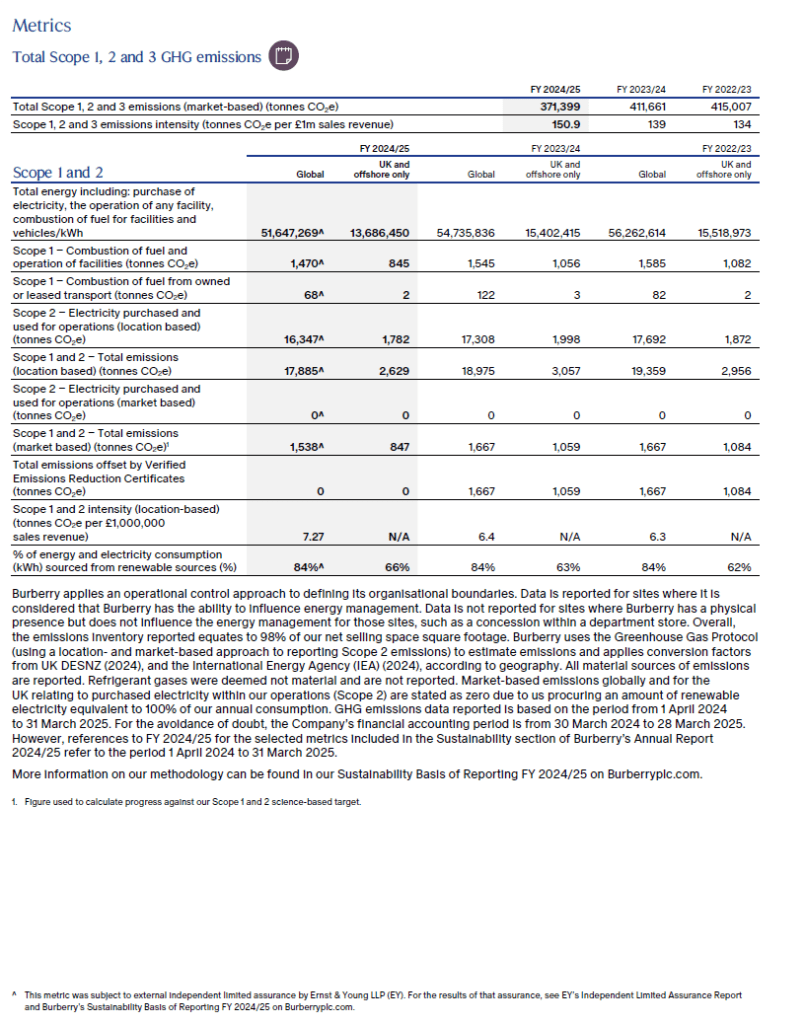
This section contains our climate-related financial disclosure consistent with the Task Force on Climate-related Financial Disclosures (TCFD) (pages 47 to 71) to comply with The Companies (Strategic Report) (Climate-related Financial Disclosure) Regulations 2022 and UK Listing Rule 6.6.6R(8). Our energy and carbon data is reported on page 58 to comply with the UK’s Streamlined Energy and Carbon Reporting requirements. We also publish a Transparency in the Supply Chain and Modern Slavery Statement on Burberryplc.com on an annual basis. This is in accordance with the UK Modern Slavery Act 2015, the California Transparency in Supply Chains Act of 2010, Canada’s Fighting Against Forced Labour and Child Labour in Supply Chains Act and Australia’s Modern Slavery Act 2018.
ENVIRONMENTAL DISCLOSURES (page 47)
Burberry’s heritage is deeply connected to the outdoors and delivering on our environmental commitments is a key area of focus for our Company. The climate crisis, water security and biodiversity loss are significant challenges faced by businesses and society at large. Our ability to address these challenges will play an important role in Burberry’s long-term success. This section highlights how our Burberry Beyond strategy mitigates risks, realises opportunities and supports the management of our most significant environmental impacts and dependencies.
CLIMATE CHANGE
Introduction
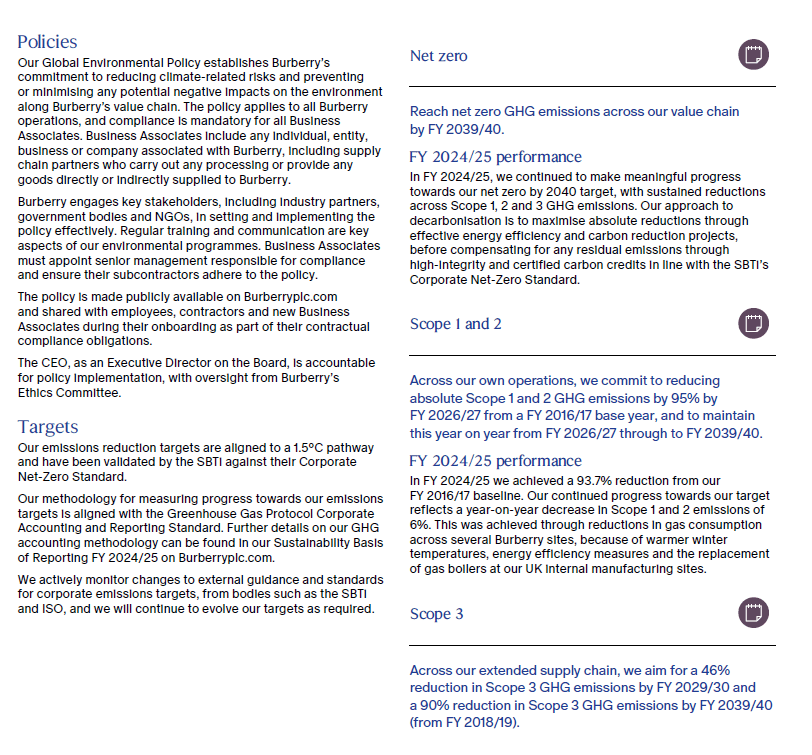
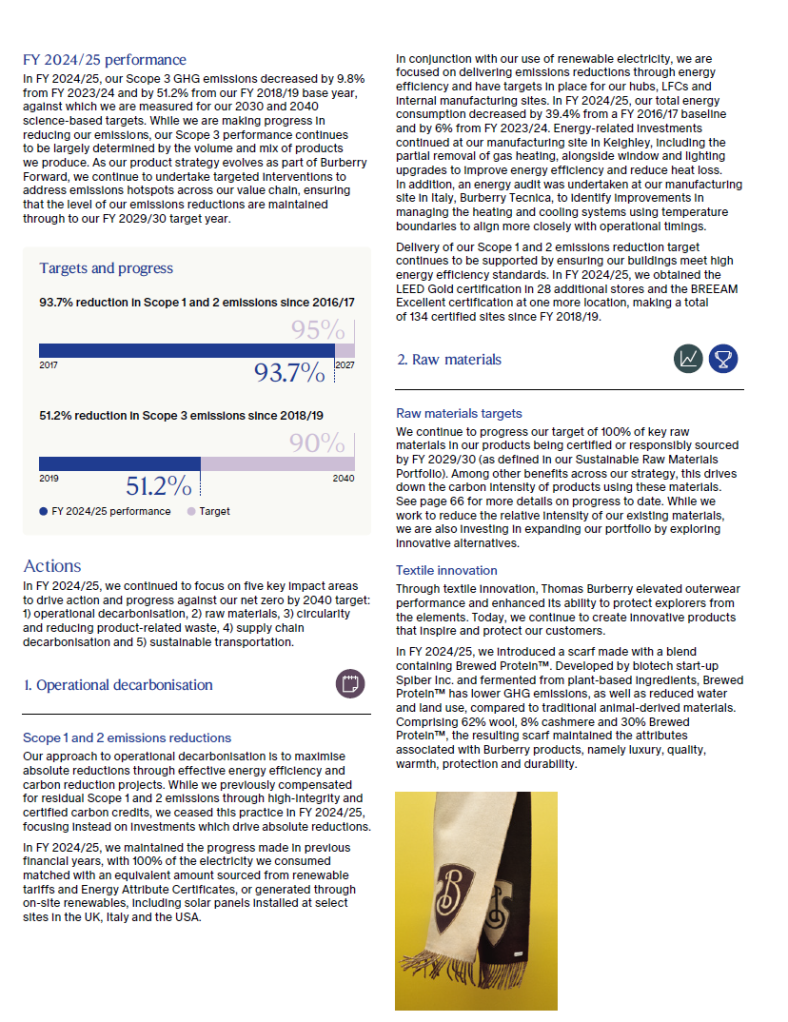
Burberry has a longstanding commitment to addressing the impacts of climate change and is taking significant steps to advance our decarbonisation agenda. Our Scope 1, 2 and 3 emission reduction targets are aligned to a 1.5°C pathway and have been validated by the Science Based Targets initiative (SBTi). Our targets support our climate-related risk mitigation and underpin our Company’s approach to adapting to climate change, providing a framework for our decarbonisation efforts across the value chain.
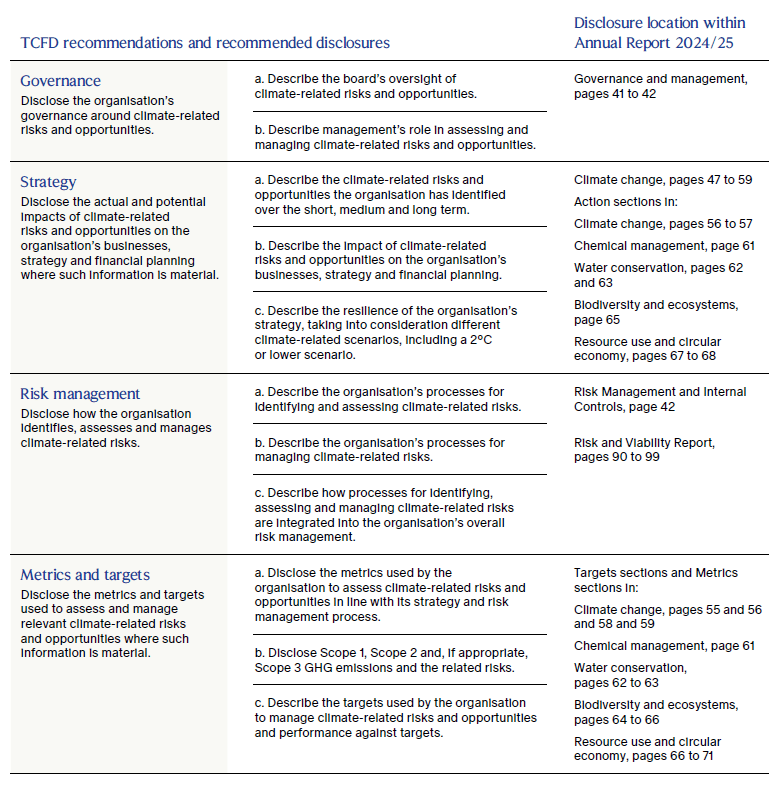
This section contains our climate-related financial disclosures consistent with the Task Force for Climate-related Financial Disclosures (TCFD) recommendations and recommended disclosures, in compliance with the Companies (Strategic Report) (Climate-related Financial Disclosure) Regulations 2022 and UK Listing Rule 6.6.6R(8). Since FY 2019/20 we have reported on its four thematic areas: governance, strategy, risk management, and metrics and targets. This year, we updated our reporting to align with upcoming reporting regulatory standards and stakeholder expectations. This builds on our previous reports and describes our approach to scenario analysis, the results of the scenario analysis and the actions taken in response to these results.
The Burberry TCFD Basis of Reporting outlines how we have prepared the Financial Statements and disclosures, considering relevant TCFD guidance publications and the principles for effective disclosure. We have engaged EY as independent practitioners to provide a limited assurance statement in accordance with ISAE 3000 on our FY 2024/25 TCFD disclosures and specific sustainability data denoted with a ^. For the results of that assurance, see EY’s Independent Limited Assurance Report and Burberry’s TCFD and Sustainability Basis of Reporting FY 2024/25 on Burberryplc.com.
Below is a TCFD index outlining where we have reported on all key disclosure requirements.
SUSTAINABILITY INFORMATION (extract pages 41-42)
3. Governance and management
Board oversight
The Board is responsible for ensuring our approach to sustainability is integrated into and implemented across the business. Our Governance Framework of committees and advisory forums provides updates and key information to the Board to ensure it can make informed decisions. This is outlined in the Corporate Governance Statement on pages 102 to 161. More detail on the roles of the Board and the terms of reference for each committee is set out in the Matters Reserved for Board Decision and the Committees’ terms of reference, which are available in the Corporate Governance section of Burberryplc.com. When reviewing annual budgets, the Board considers sustainability-related issues, including spend associated with our Burberry Beyond strategy, capital expenditure relating to improving energy efficiency in our own operations, and colleague bonuses aligned to our sustainability targets. The Board is also responsible for overseeing and monitoring the management of risks and opportunities, including those related to climate change.
Further information on the risk management approach is included in the Risk and Viability Report on pages 90 to 101.
Management oversight
The CEO has accountability for sustainability performance at executive level and delegates managerial oversight of environmental and social responsibility matters to our Corporate Responsibility team. Led by the Vice President of Corporate Responsibility, the team’s expertise ranges from carbon accounting through to sustainable raw material sourcing and ethical trading. The Corporate Responsibility team acts as a centre of excellence, guiding the execution of our Burberry Beyond strategy by collaborating with teams across the business, including Sustainable Finance, Sustainable Information Technology (IT), Legal, Product, Supply Chain and Human Resources.
The Company’s strategy on environment-related issues, Burberry Beyond, is governed by the Sustainability Committee, which convened three times in FY 2024/25 and is chaired by the CEO. The Committee plays an important decision-making role in supporting Burberry’s environmental agenda, with membership including senior leaders from across the organisation who are responsible for the execution of the strategy within their respective business areas. In FY 2024/25, topics discussed by the Sustainability Committee included future climate-related disclosure requirements, product sustainability and our ReBurberry services. During FY 2024/25, the Board received two updates from the Sustainability Committee, which included progress against the Company’s sustainability-related goals and targets. The Board also received an update on Burberry’s decarbonisation plans and disclosures.
The Ethics Committee oversees the Company’s governance and strategy relating to our social agenda, including the governance of human rights risks and due diligence in our supply chain. Where risks are identified, they are reported by management to the Ethics Committee, which reports directly to the Audit Committee. The Ethics Committee also has oversight of our community investment work as it reviews the Company’s charitable donations twice a year. The Board also receives an annual update on the Company’s community agenda and approves the budget for charitable donations.
The Risk Committee, which is chaired by the CFO, is responsible for managing and monitoring sustainability-related impacts, risks and opportunities and has oversight of the Company’s climate-related financial risk disclosures and preparations for upcoming reporting regulations. The Audit Committee also receives updates on the Company’s preparation for upcoming regulatory requirements and recommends the annual sustainability and risk-related disclosures for approval by the Board.
The Board reviews our sustainability reporting as part of its overall assessment of the fair, balanced and understandable nature of the Annual Report.
Knowledge and skills
Burberry seeks to ensure that our Board and senior leadership have the relevant knowledge and skills to help us build a business that is both successful and responsible. Details regarding Board members’ sustainability skills and experience are included in the biographies section on pages 104 to 108.
We aim to educate colleagues on various sustainability-related topics through frequent engagement and communications, focused events and volunteering opportunities. Internal communications include a weekly fast-fact series and a monthly sustainability newsletter consisting of product launches, industry news and updates, and learning resources.
In FY 2024/25, we launched Choose Our Future: The Climate Game. Designed by Burberry colleagues, for Burberry colleagues, the digital tool is a tailored, colleague-owned learning experience designed to equip teams with the knowledge they need to enable sustainability-related decision-making. The game was introduced across our Marketing and Retail functions in March 2025, with first versions available in English, Simplified Chinese, Traditional Chinese, Korean and Japanese. In FY 2024/25, we also launched an online modern slavery training programme, which is mandatory for colleagues in Supply Chain, Corporate Responsibility, Procurement and relevant Human Resources roles. In addition, we provided training for around 700 Supply Chain and Product Development colleagues on sustainability topics, including product sustainability, responsible sourcing and our Burberry Beyond strategy.
Beyond digital engagement, we also connect with colleagues through in-person events, such as our Sustainable Product and ReBurberry Showcase. This event invited colleagues to learn more about various Burberry sustainability initiatives and experience our circular services firsthand, including our Cashmere and Leather Refresh services and fragrance refills. Attendees could also meet with teams working on sustainability, including colleagues from our Internal Manufacturing team.
We are building capabilities across the business to ensure teams have the relevant sustainability-related knowledge and skills to support decision-making. Team members involved in the execution of the Burberry Beyond strategy participate in external training courses and educational events, including the Accounting for Sustainability (A4S) Academy, to keep abreast of relevant climate- and nature-related topics. We will continue to expand our sustainability training, with a particular focus on developing the relevant skills, knowledge and competencies required for colleagues to contribute to the delivery of our strategy.
Remuneration
The remuneration of the Executive Directors is partly linked to our progress in building a more sustainable future, including progress towards the Group’s longer-term climate goals, via the annual bonus plan and a sustainability underpin in the Burberry Share Plan (BSP).
For FY 2025/26, 25% of the annual bonus for Executive Directors will be linked to performance against strategic objectives linked to our strategy and brand, as well as our sustainability targets.
There will be a sustainability underpin in the 2025 BSP award for the Executive Directors.
Since FY 2023/24 we have linked a proportion of our discretionary annual corporate bonus plan for the wider workforce to the achievement of sustainability metrics.
Statement on sustainability due diligence
During FY 2024/25, we continued to meet and prepare for current and future due diligence legislation in line with the expectations of our external stakeholders, such as international regulators, consumers, investors and governments. A cross-functional team of experts has been set up to focus on developing an aligned approach to human rights and environmental due diligence. This builds on our well-established due diligence practices, by identifying opportunities to strengthen and integrate processes across social and environmental risks and impacts, and enhancing the effectiveness of our overall Due Diligence Framework. Our approach prioritises improving labour conditions, creating positive impacts and driving efforts to address endemic human rights issues, while advocating for sustainable change across the industry with our key stakeholders. Full details of our approach are available in our Transparency in the Supply Chain and Modern Slavery Statement FY 2024/25 available on Burberryplc.com.
Risk management and internal controls
The overarching approach to identifying sustainability-related risks is the same as for all principal risks, which is detailed on pages 92 to 93. For each risk, including climate change and supply chain impacts, we have a Risk Management Framework detailing the controls in place and those responsible for managing the overall risk and the relevant mitigating controls. We monitor risks throughout the year to identify changes in principal risk profiles. Management of sustainability-related risks is distributed throughout the organisation, depending on where the risk resides. For example, climate-related risks in relation to raw materials in the supply chain are managed by our Raw Material Procurement team responsible for buying materials.
When sustainability-related risks are assessed, existing mitigating activities and controls are highlighted and, where relevant and appropriate, additional activities and controls are implemented if risks fall outside of risk tolerance. Progress against these mitigating activities is assessed by the appropriate committee responsible for monitoring the associated risk (as described in the Management oversight section on page 41).
Sustainability-related risks and opportunities are continually monitored as part of our Enterprise Risk Management Framework. This allows us to evaluate the relative significance of our risks based on their likelihood and impact, and to prioritise accordingly. The business has also developed a risk platform, which enables us to track our business objectives, including those which create or protect financial, social, environmental and reputational value.
We also scan for new and emerging risks and keep abreast of evolving regulatory requirements.
Approach (page 49)
Strategy
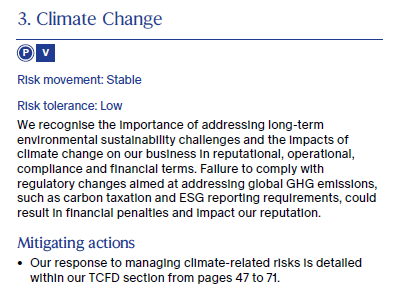
Climate change has been identified as a principal risk to Burberry and has the potential to impact our business in the short, medium and long term. Our strategy to address climate‑related risks is integrated into our business strategy and decision-making in areas such as capital allocation, investment appraisal, supply chain planning and raw material sourcing.
Background to scenario analysis
Scenario analysis is a process for identifying and assessing the potential implications of a range of plausible future states under conditions of uncertainty. Scenarios are hypothetical constructs and not designed to deliver precise outcomes or forecasts.
Instead, scenarios provide a way for the business to consider how the future may look if certain trends continue, or certain conditions are met, and to assess Burberry’s strategic resilience.
Climate-related risk scenario analysis is led by Sustainable Finance, with input from Supply Chain, Corporate Responsibility, Commercial and Finance teams across the business.
Our approach to scenario analysis
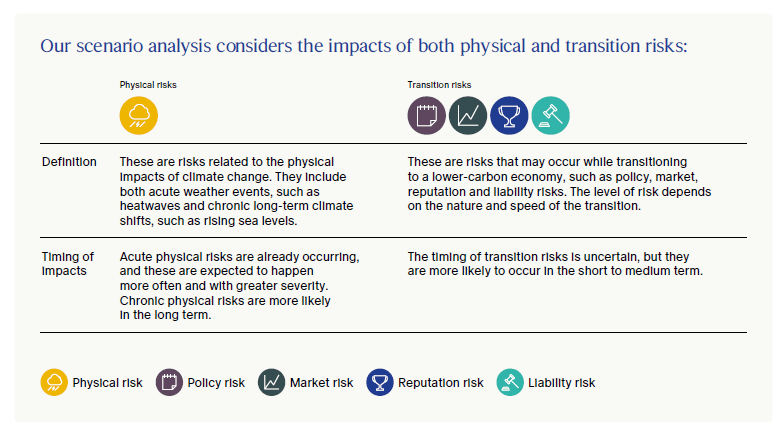
Our scenario analysis incorporates the Company’s financial forecasts, operational footprint, supply chain information and environmental data to create a digital twin representation of the business. The product portfolio is modelled based on our strategy, with the Company’s value chain being modelled using historical data. This information is combined with industry reference scenarios on climate emission pathways, including assessments by the Intergovernmental Panel on Climate Change and International Energy Agency, to consider the potential impact of physical and transition risks on the business.
Time horizons considered
We have defined our time horizons as:
- short-term (five years)
- medium-term (five to 20 years)
- long-term (more than 20 years)
The time horizon used for our detailed scenario analysis is a short-term outlook of five years, during which we can influence decisions through strategy, capital allocation, costs and revenues. Typically, three years is used for our financial and operational planning, as this is sufficient to cover the majority of approved capital expenditure projects, and most current business development projects will be completed in this period.
Our viability assessment is also aligned to this time period, with going concern typically considered over 18 months. For the purposes of scenario analysis, we have extended the period to five years using a growth assumption, which more closely aligns with our expected asset lifetimes and strategic plans.
Furthermore, we have used our detailed five-year analysis to consider how climate-related risks may evolve over 10 years, to further guide the development of our climate strategy.
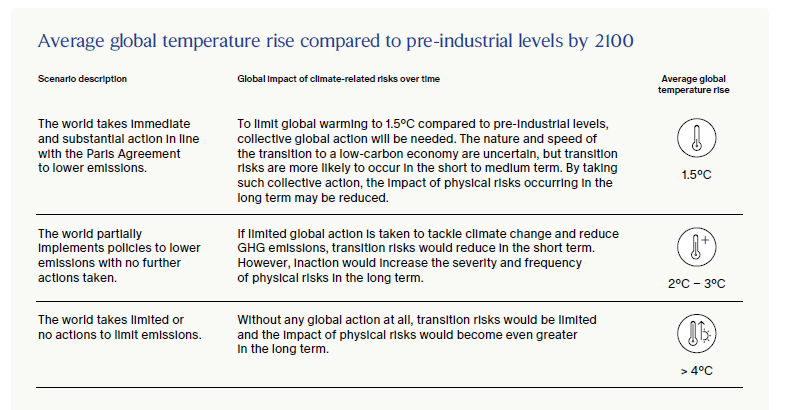
Results of our scenario analysis
The output of our scenario analysis considers the financial impact of climate-related risks on Burberry. This entails estimating the loss of value to the Company’s discounted cash flows over the next five years assuming no mitigating actions are taken.
Detailed risk analysis
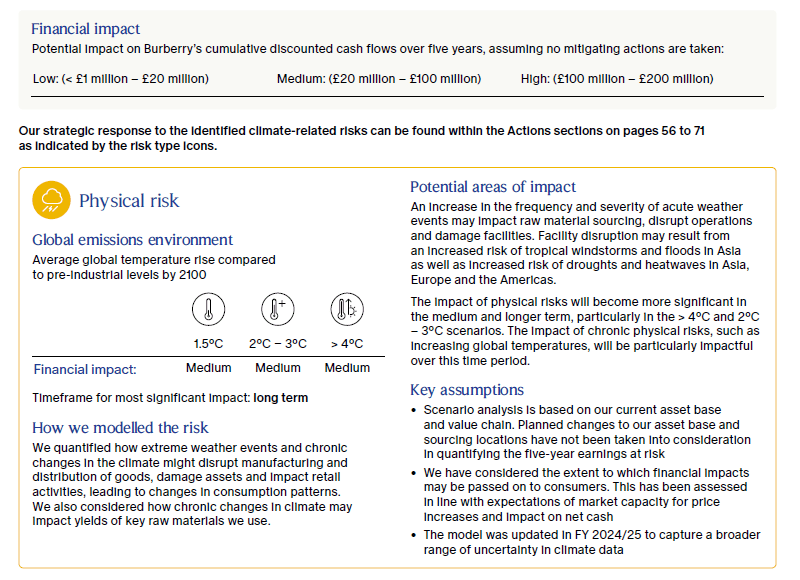
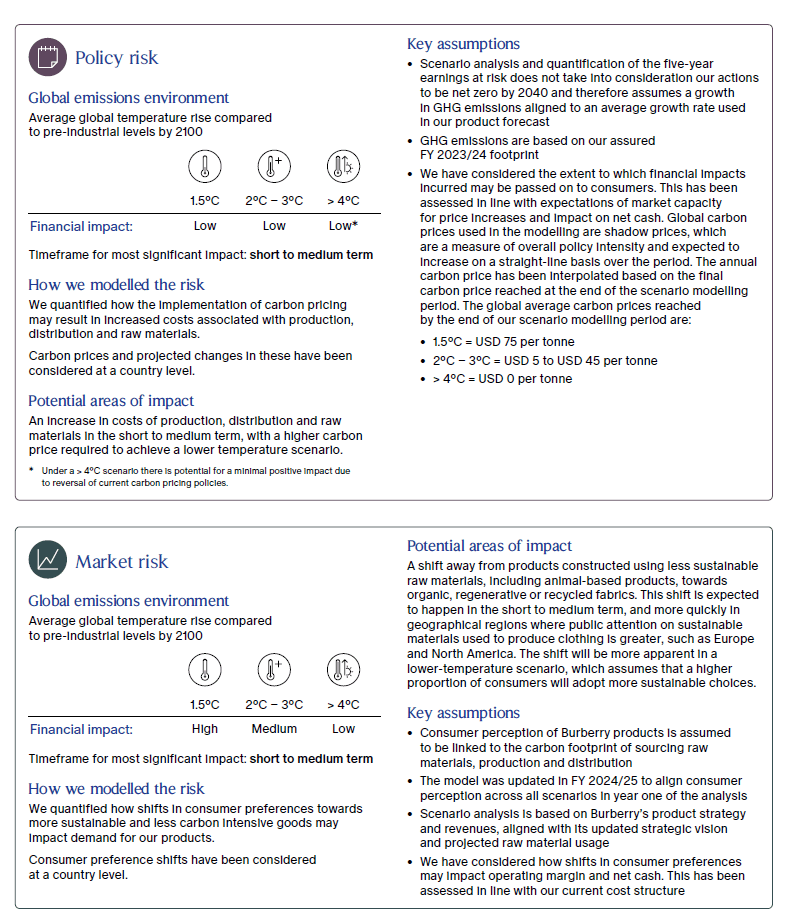
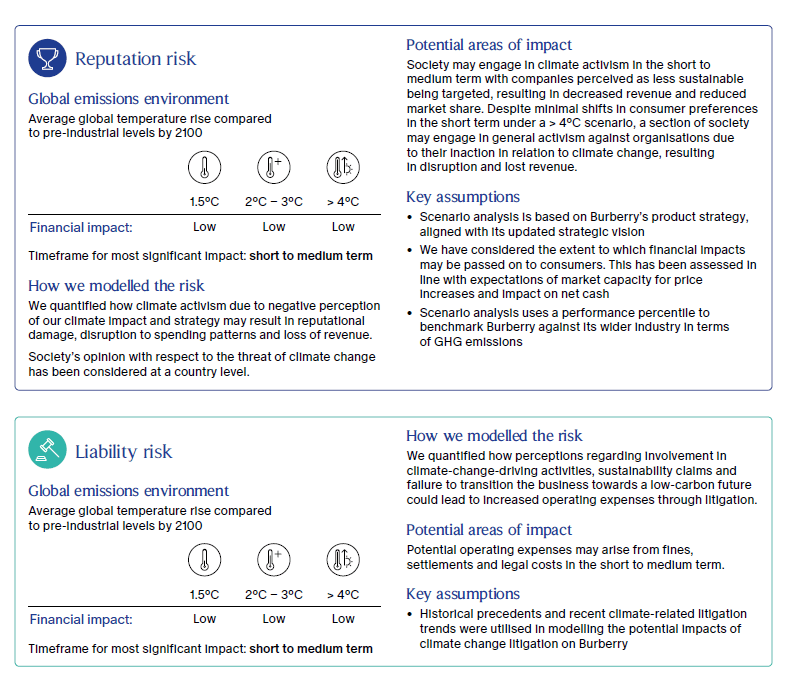
This section details the approach and results of our scenario analysis for each modelled risk. The financial impact reflects the estimated loss in the Company’s discounted cash flows over the next five years, assuming no mitigating actions are taken. This impact has been categorised as ‘High’, ‘Medium’ or ‘Low’, reflecting materiality to the Company’s Financial Statements. In FY 2024/25 we adjusted our financial impact thresholds to ensure the severity of risk impacts is appropriately reflected in the disclosure below.
Opportunities
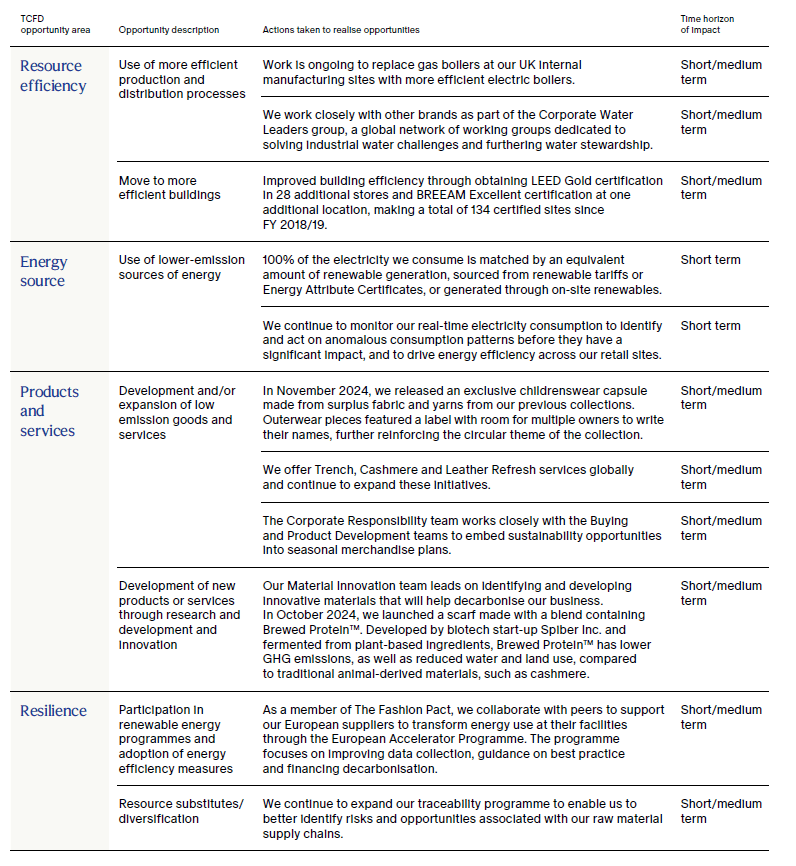
In addition to climate-related risks quantified through scenario analysis, Burberry continues to identify and act upon climate-related opportunities aimed at supporting the Company’s overarching net zero ambition. The Sustainability Committee plays a pivotal role in identifying, prioritising and realising climate-related opportunities. The Committee receives pertinent opportunities from internal teams working on the environmental agenda, which are then evaluated for feasibility and potential impact, as well as their alignment with key priorities.
Examples of such climate-related opportunities are summarised below.
Summary of response to scenario analysis
At Burberry, we believe our long-term success depends on actively addressing the potential impact of climate-related risks and adapting to potential opportunities. As such, we have adopted strategies and actions to mitigate these risks and ensure our strategy adapts to the potential opportunities. Where such actions have quantifiable investments associated with them, these are embedded within our Board-approved financial plans, which are translated into annual budgets.
We have also considered the impact of climate change in the preparation of our Financial Statements, which can be found on page 166. As the scientific understanding of climate change and availability of data evolves, we expect greater rigour and sophistication in the approach to scenario analysis. We aim to continue developing and updating our scenario analysis to support our assessment of the resilience of our business strategy to climate-related risks and ensure relevant mitigating strategies are in place.
Details on targets and metrics aligned to the identified climate-related risks can be found within the Targets and Metrics sections on pages 55 to 71 as indicated by the risk type icons.
RISK AND VIABILITY REPORT (extract)
Strategic Report | Principal Risks (extract)
 Accounts examples